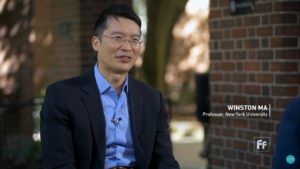
Governments are increasingly investing in sovereign funds to steer their investments into AI, copying China’s strategy, says Winston Ma, investor, attorney, author, and adjunct professor focused on the global AI economy, in The Innovator. Winston Ma wrote ten books on the digital economy, including The Digital War: How China’s Tech Power Shapes the Future of AI, Blockchain and Cyberspace.
The Innovator:
Q: Do you consider it to be a logical next step for governments to create AI sovereign wealth funds given that sovereign funds are already the largest investors in AI?
WM: Exactly. The U.S. sovereign fund (and its Intel investment, among others) is a new phenomenon, but my Hunt for Unicorns book, which was published in 2020, was already talking about how sovereign funds globally — from the Middle East, China, Korea, Singapore, and Southeast Asia — were investing in tech, including AI.
Today government sovereign funds are the biggest investors in AI. Look at Anthropic: it’s the most valuable AI startup (and its CEO said the total addressable market exceeds $30 trillion). Most recently, the two largest rounds were led by Singapore GIC, the Singapore Government Investment Corporation.
The same is true for data centers. There’s a digital infrastructure investment consortium with the potential to invest $100 billion known as the Artificial Intelligence Infrastructure Partnership (AIP), co-led by BlackRock, the world’s largest alternative assets manager, and its subsidiary Global Infrastructure Partners (GIP), as well as a few major sovereign wealth funds, including Singapore’s Temasek, Abu Dhabi’s MGX, and Kuwait’s KIA.
When it comes to public AI stock trading, Norway’s sovereign investment fund is one of the largest public market investors in Nvidia, which dominates the AI chip layer, and it has huge voting power in many AI and tech companies because of its public holdings. These are 100% state-owned investment vehicles investing into the full AI stack.
The year 2026 is the start of a new phase: since public investment funds like those listed above are already financing the entire AI stack, formally establishing AI’s own sovereign wealth funds — such that AI gains can be shared as public benefits — is the natural institutional evolution.
Q: There is a very good reason for governments to invest. The Tony Blair Institute for Global Change noted in a recent report that compute is not just a source of scientific and economic progress, but the new benchmark of global power economically and geopolitically.
WM: It’s not the compute alone; it’s the overall AI stack.
Q: This is why the whole issue of sovereignty has become so important in Europe because it doesn’t control the full stack.
WM: That is precisely the point. True AI sovereignty requires alignment across all five layers: securing energy baseload, manufacturing silicon, building data centers, hosting proprietary or open-weight models, and deploying productivity applications.
China has focused heavily on using sovereign vehicles to capitalize this stack. In addition to the well-known CIC sovereign wealth fund, where I worked as a financial investor managing a global market portfolio, China also established the National Integrated Circuit Industry Investment Fund (“Big Fund”). Its $47.5 billion Phase III, launched in late 2024, directly targets advanced semiconductors, yielding major market listings like ChangXin Memory Technologies (CXMT) — China’s domestic answer to both U.S.-based Micron and South Korea’s Samsung.
In January 2025, Big Fund III co-founded the $8.2 billion National AI Fund. When Chinese AI startup DeepSeek raised its external financing round, the National AI Fund contributed a ¥1 billion check. Although smaller than the non-voting capital injected by commercial giants like Tencent and CATL, the state fund took the only position with direct governance voting rights.
Q: So when the U.S. government takes a 10% share in Intel, they’re essentially copying China?
WM: Exactly. Trump is taking a page out of China’s sovereign AI playbook — that’s the title of my Financial Times op-ed in June.
Winston Ma is a speaker at the China Speakers Bureau. Do you need him at your meeting or conference? Do get in touch or fill in our speakers’ request form.
Are you looking for more experts on innovation? Do check out this list.


 .
. 

