Weblog with daily updates of the news on a frugal, fair and beautiful China, from the perspective of internet entrepreneur, new media advisor and president of the China Speakers Bureau Fons Tuinstra
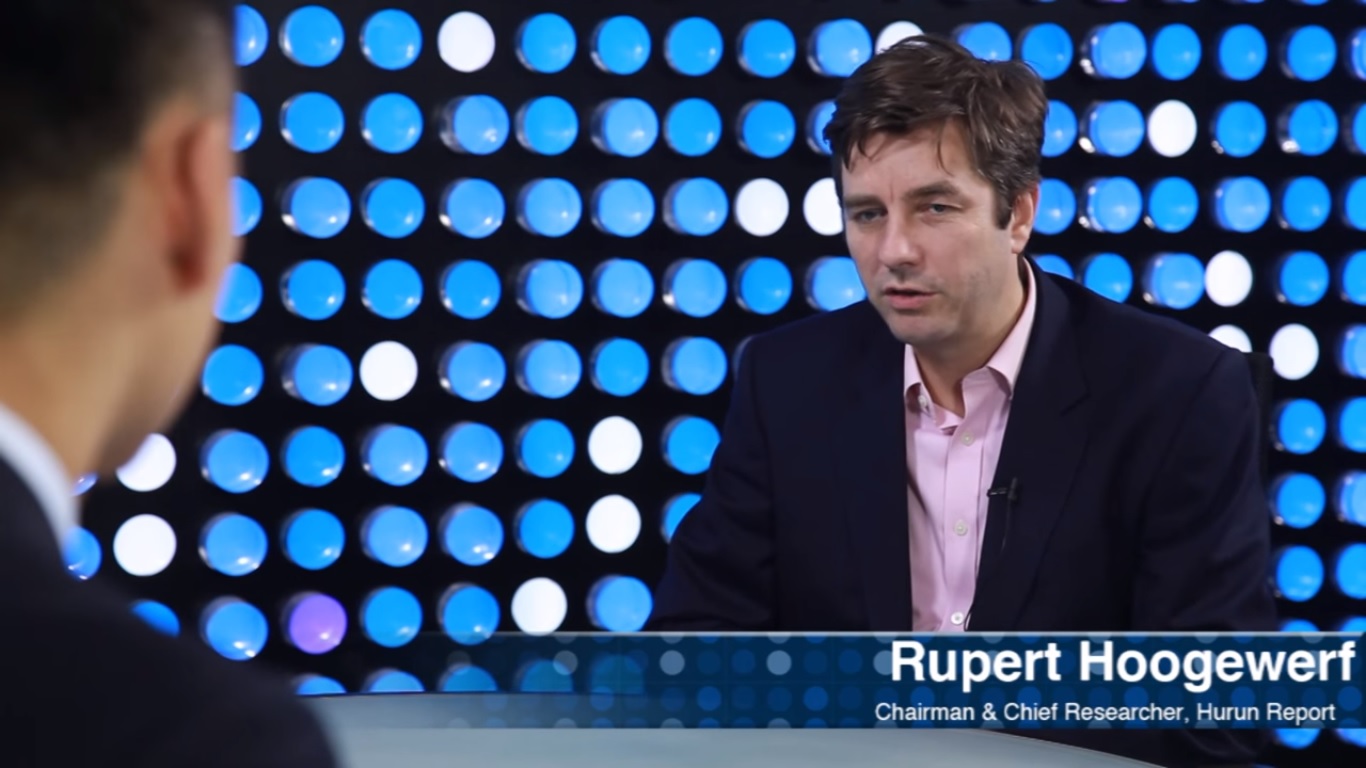
Chinese companies look for global markets, and South East Asia is the number one stop, says Hurun Report Chairman and Chief Researcher Rupert Hoogewerf in the China News Service. Next is Europe, but Southeast Asia is certainly leading, he says.
China’s electric car makers saw their value rise over the past post-corona months, as they believe they can produce an alternative for US-car maker Tesla, says Rupert Hoogewerf, chairman of the Hurun China rich list to the South China Morning Post.
The South China Morning Post:
The California-based marque leads China’s premium electric vehicle segment, buoyed by locally built Model 3 sedans. Tesla delivered 79,908 made-in-Shanghai Model 3s in the first nine months of this year, beating its Chinese rivals by a large number amid a slump in the overall market due to the Covid-19 pandemic.
In September, Nio delivered 3,226 of its ES6 sport-utility vehicles, a year-on-year increase of 87 per cent. But it was still behind Tesla by quite a distance, as the US company sold 11,329 Model 3s the same month.
Rupert Hoogewerf, the chairman and chief researcher at Hurun Report, which compiles the Hurun China Rich List, said the rallies in Chinese electric carmakers had resulted from a belief that they would evolve into China’s answer to Tesla in the future.
“The sector is interesting to watch because they are potential game changers in the automotive industry,” he said. “We don’t know the answer yet to whether they can become powerful players in the fast-changing automotive industry.”
Digital insurance has become one of the post-corona winners in China, says Rupert Hoogewerf, chief researcher of the Hurun China Rich List as his firm published the first list of top-10 digital insurers, according to Asia One. Health insurance was one of the key winners, he says.
Asia One:
The post-pandemic era has seen health becoming one of the hottest topics and diversified insurance products, said Rupert Hoogewerf, the chairman and chief researcher of Hurun Report. Quoting statistics from Insurance Association of China, Hoogewerf said Chinese insurers’ premium income increased by 6.5 percent year on year to 2.7 trillion yuan in the first half of the year.
Insurance agencies have played a crucial part in insurance purchases, whose premium income has accounted for over 80% of the total premium income for the past consecutive years, Hoogewerf noted, adding that the practice of independent service providing and marketing has shaped the insurance sector, and, at present, near 70% of China’s 700 national insurance agencies are eligible to market online.
Digital insurance in China has enjoyed leap-forward development in the past years, Hoogewerf said. He further explained that, besides internet giants Baidu, Alibaba, Tencent and JD.com, Ctrip, Didi, Meituan and other platforms have rolled out insurance services. Relying on massive active users and taking advantages of big data and cloud computing technologies, those companies have designed insurance products in accordance with the consumption scenarios of their original platforms, including entertainment, shopping, travelling and mutual health aid, to meet the insurance needs of different customer groups, said Hoogewerf. For instance, Hoogewerf added, Ant Insurance provides shipping insurance for online shopping and Ctrip offers insurance for flight accidents and delay.
In digital insurance business, there are other companies that worth gaining people’s attention, such as scenario-based health insurance marketing agencies represented by Qingsong Health Group’s insurance platform, and China’s earliest online platforms that obtained online insurance brokerage licenses represented by Huize Insurance, said Hoogewerf.
As insurtech embraces a new development era in both China and the global market, multiple business players have been competing for the position of industry leaders, Hoogewerf noted. He said the prospects of Chinese digital insurance agencies are promising, given the trend of independent service providing and marketing in insurance industry as well as the rapid development of internet technology.
The massive drop of stock markets has wiped away unprecedented amounts of capital, says Hurun China Rich List founder Rupert Hoogewerf at the South China Morning Post. But in that bloodbath, China has been a relatief winner, he adds.
The South China Morning Post:
While most billionaires have seen their fortunes shrink drastically amid a stock market rout brought on by the Covid-19 pandemic and containment measures launched by governments, a handful have seen their wealth rise – significantly.
According to research by Hurun Report calculating the pandemic’s impact on billionaires’ fortunes, Eric Yuan, the US-based founder and chief executive of Zoom, the video conferencing software company, saw his net worth skyrocket by US$3.5 billion – or 77 per cent – to US$8 billion. This makes him the fast riser of the past two months.
Zoom has become ubiquitous as executives at companies around the world try to stay in touch while working from home.
“The last two months have wiped out all the wealth made in the past two-and-a-half years, with the World’s Top 100 down 12.6 per cent, or US$408 billion, equivalent to each of the Hurun Top 100 losing US$75 million a day,” said Rupert Hoogewerf, Hurun Report’s chairman and chief researcher.
“China has been the relative winner,” he said. The country added six billionaires to the top 100 list, while India lost three and the US lost two. He said that the Hurun Report had 2,816 known billionaires before the Covid-19 pandemic, but that number had dropped by 20 per cent, as tanking stock markets wiped out net worth estimations.
Vision, robotics and language are key areas where China is worldwide leading the AI, says Rupert Hoogewerf, chairman of the Hurun report on artificial intelligence. The number of patent applications has been rising sharply over the past five years, he adds in the South China Morning Post. Huawei holds a top position.
The South China Morning Post:
Tencent is one of the main champions of AI technology in China’s medical industry while Baidu is a key AI player in smart homes and smart driving, said the report.
E-commerce powerhouse Alibaba, leading Chinese surveillance camera maker Hikvision, voice-recognition developer iFlytek and state-owned power company State Grid also made it to the top 10...
“The number of AI patent applications has risen rapidly in the past five years, and China is the world leader especially in the fields of vision, robotics and language,” said Hurun Report chairman and chief researcher Rupert Hoogewerf, also known by his Chinese name Hu Run.
Unlike many leading Chinese technology firms that primarily focus on software development, Huawei and Hikvision are also major chip designers.
Both were included in the US trade blacklist, officially called the Entity List, earlier this year. Their inclusion in the list effectively bars them from purchasing US goods, as the world’s two largest economies extend their trade competition into technology.
The 10 top unicorns, businesses created in the 2000s, are worth US$542 billion, according to Hurun Research.
Hurun Research Institute has released the inaugural Hurun Global Unicorn List for 2019. All the top unicorns are not on a stock exchange and valuations are a snapshot on 30 June.
“We have found just under 500 unicorns in the world. The Hurun Global Unicorn List 2019 is designed to inspire entrepreneurship among wannabe entrepreneurs and encourage investors. These young companies, only seven years old on average, are the world’s most exciting start-ups, leading a new generation in disruptive technology,” said Hurun Report Chairman and Chief Researcher Rupert Hoogewerf, also known by his Chinese name Hú Rùn.
Hurun Research Institute found 494 unicorns in the world, based in 25 countries and 118 cities. They were created seven years ago on average, are worth US$3.4 billion on average and US$1.7 trillion in total.
China's philanthropists spend most of their money on education, followed by poverty alleviation, says the 2019 Hurun Philanthropist List, according to the Shanghai-based Hurun chief researcher Rupert Hoogewerf in a press release. Automotive executive of China’s largest auto components company Wanxiang Group tops the list with US$720 million.
Hurun:
Lu Weiding, chief executive of China’s largest auto components company Wanxiang Group, became the country’s most generous philanthropist, with a single donation of US$720 million in the year ending March 31, according to Hurun Philanthropist List.
Lu, 48, nicknamed “Auto Parts King,” made the donation through shares of a subsidiary that went public to a charitable trust in memory of his father, Lu Guanqiu.
Lu Guanqiu founded Wanxiang in Hangzhou, Zhejiang, with about US$500 in 1969, which is about US$3,500 in 2019 dollars. He grew the company from a farm tool manufacturer into a multinational conglomerate with business in auto parts, real estate, agribusiness, and finance. He died in 2017 at age 72.
Lu Weiding and his family has a net worth of US$6.5 billion, according to Hurun’s estimate.
Occupying the second spot on the 2019 Hurun Philanthropist List was Chen Yidan, 48, co-founder of Chinese internet giant Tencent Technology, based in Shenzhen. He made a US$500 million gift, mainly made up of Tencent shares. In 2016, he established the Yidan Prize with a US$320 million donation, giving US$2 million each year to two individuals who make significant contributions to education.
Xu Jiayin, 61, ranked third with a US$230 million donation. Xu has a net worth US$37 billion through his 77% stake in the Guangzhou-based Evergrande Group.
In total, 114 Chinese philanthropists donated US$3 million or more in the year leading up to March 31, according to Hurun, which began to compile the list 16 years ago. Total donations, based on cash, cash equivalents, and legally binding commitments, were down 3% year-over-year to US$3.2 billion.
“The preferred cause of China’s top philanthropists has been education, although poverty alleviation has grown dramatically to become the second most popular cause this year,” said Rupert Hoogewerf, chairman and chief researcher of Hurun Report, in a news release.
Education accounted for 35% of total donations. while the proportion of donations to poverty alleviation increased to 29% from the 18% reported a year ago.
The Hurun Global Real Estate Rich List, released last week, shows that China has the most real estate billionaires, followed by the US. The country's building boom caused by massive urbanization explains the top position, says Rupert Hoogewerf, chief researcher of the Hurun rich list to Barron's.
Barrons:
With 139 of the world’s 239 real estate billionaires, China accounted for a whopping 58% of the world’s total, leaving other countries far behind, according to the Hurun Global Real Estate Rich List released Thursday. The runner-up, the U.S. has 26 real estate billionaires, followed by the U.K., with 17.
Hong Kong had the highest concentration of real estate billionaires in the world with 25.
“The urbanization megatrend in China has driven the biggest wealth explosion in the history of world, with the result that most of the world’s largest real estate developers today come from China,” Rupert Hoogewerf, chairman and chief researcher of Hurun Research Institute, publisher of the list, said in a statement.
Chinese developers swept the list’s top four spots. Xu Jiayin of Shenzhen-based Evergrande Group ranked first with a net worth of US$37 billion. Li Ka-shing of Hong Kong conglomerate Cheung Kong Holdings came in second, with US$29 billion.
Third place went to Lee Shau Kee of Hong Kong-based Henderson Development, with US$27 billion. Yang Huiyan of Foshan-based Country Garden landed fourth with US$23 billion. She was the only female real estate billionaire in the top 10.
The richest U.S. real estate billionaire was Donald Bren, chairman and sole owner of California-based developer the Irvine Company. He had a net worth of US$17 billion.
U.S. President Donald Trump came in at 82nd place with US$3 billion.
The Hurun Education Top International Schools in China 2018surveyed at least 330 school principals, senior teachers, investors, overseas study agents, and even government departments, in China between July and December 2018.
In the second year of the ranking, Beijing replaced Shanghai as the city with the most international schools on the list, Rupert Hoogewerf, chairman and chief researcher of Hurun Education, highlighted.
In total, 26 schools in Beijing made the top 100 list, compared to 23 in Shanghai. Last year the figures were 21 and 26, respectively.
The top 100 came from 24 cities across Mainland China, and two-thirds of the list camefrom Beijing, Shanghai, Guangzhou and Shenzhen.
The proportion of schools included that admit Chinese passport holders rose from 70% to 80% since last year’s ranking – eight of the top 10 schools are able to admit Chinese passport holders, up four from 2017.
“This ranking is primarily targeted at parents with children in China, helping them to find the most suitable school for their child, teachers already at or looking to work at international schools in China and admission officers of universities looking to recruit students from China,” Hoogewerf said.
The number of billionaires from China might be growing fast, US billionaires still earn far more, says Hurun China Rich List founder Rupert Hoogewerfto the Washington Post. The wealthiest in China was e-commerce giant Alibaba's founder Jack Ma, the world's 22nd-most-wealthy person, with US$39 billion.
The Washington Post:
The biggest gains in wealth last year came in the areas of technology, media and telecommunications, followed by real estate and other investments, manufacturing and retailing.
The wealthiest in China was e-commerce giant Alibaba's founder Jack Ma, the world's 22nd-most-wealthy person, with $39 billion. Pony Ma Huateng of the Internet giant Tencent Holdings, with $38 billion, and Xu Jiayin of property developer Evergrande, with $37 billion, were close behind.
Though people in China and other Asian nations are steadily gaining in wealth, Amazon founder Jeff Bezos topped the global chart for the second year running, with wealth estimated by the Hurun rich list at $147 billion. Bill Gates ranked second, with $96 billion, and Warren Buffett was third, with $88 billion.
Gates' fortune rose by $6 billion in 2018 despite his enthusiasm for philanthropy, said Hurun Report Chief Executive Officer Rupert Hoogewerf.
President Donald Trump's wealth fell by $500 million last year, the report said, to $3 billion, or 793rd.
The only Asian among the 10 richest people in the world was Mukesh Ambani of Indian conglomerate Reliance Industries, who ranked No. 8 with wealth estimated at $54 billion.
"Poor stock market performances and an appreciating dollar were the main reasons for this year's record drop in billionaires," Hoogewerf said in a statement. "Despite the strong dollar and its tax cuts, the USA added only 13 billionaires, but made it harder for the rest of the world to make the cut."
Overall, the report said, there were 2,470 billionaires in the world, down 224 from last year. Their total overall wealth fell by $950 billion from the year before, to $9.6 trillion, because of stock market gyrations and a strong U.S. dollar, it said.
Hoogewerf said he believes that the world's billionaires may number more than 6,000 people, since many seek to hide the extent of their wealth, especially in the Middle East. Forty billionaires from last year's list died in 2018.
The newly minted Chinese billionaires included Colin Huang Zheng of e-commerce platform Pinduoduo and restaurant-group owner Zhang Yong and his, wife Shu Ping. Others were Zhang Yiming of ByteDance, an Internet technology firm valued at $75 billion, and Zhan Ketuan of bitcoin miner Bitmain.
Global gloom has hit billionaires worldwide, but especially in China, as 213 lost their position at the China Hurun rich list. Globally 430 dropped off the global edition. Poor performance of the stock markets mainly caused the drop, says Rupert Hoogewerf, chief researcher of the Hurun rich list in the South China Morning Post.
The South China Morning Post:
A record 213 Chinese billionaires dropped out of the widely watched Hurun Global Rich List, as slumping stock markets worldwide wiped out a combined US$1 trillion from the fortunes of the world’s wealthiest individuals, a report released on Tuesday showed.
Only 658 super-rich individuals living in the Greater China region made it to the 2019 list, down from 819 last year.
The squeeze felt by Chinese billionaires was much deeper than their peers in other countries, as the country’s worst stock market performance in four years was compounded by a weak yuan.
A year-long bearish stock market, partly attributed to the trade dispute between the United States and China and partly caused by a slowing economy and Beijing’s deleveraging campaign, saw the Shanghai Composite Index drop 25.7 per cent year on year as of January 31 – the cut-off date for the Hurun list. During the same period the Chinese stock market lost 13 trillion yuan (US$1.9 trillion) in market capitalisation.
“A big drop in the Chinese stock market coupled with a 6 per cent drop in the Chinese yuan were the main causes of the drop in [the number of billionaires from] China,” said Rupert Hoogewerf, chairman and chief researcher at Hurun Report, which compiles the list of individuals with a wealth of more than US$1 billion.
The stagnation of China's growth caused a massive drop of rich out of the Hurun China Rich List, says Hurun chief researcher Rupert Hoogewerf. But that drop has been more than compensated by the record growth of new unicorns in the country, he tells the South China Morning Post. China fostered almost 100 new unicorns in 2018.
The South China Morning Post:
“This year, we have a record high number of people dropping from our Hurun China Rich List because of an economic slowdown,” said Ruper Hoogewerf, the chairman and chief researcher at Hurun, in a statement on Thursday.
“However, there are still more than 200 new billionaires on the rich list and the leading companies of these new billionaires are these unicorns.”
The latest Hurun findings further burnish how China’s start-ups – in industries spanning e-commerce and financial technology to transport and artificial intelligence – have helped transform the way the country’s people shop, travel, invest, eat and get entertainment over the past decade, riding on a flood of enthusiastic investments from domestic and overseas venture capitalists.
On-demand internet services unicorns, however, increased the most to 45. These include car-hailing app operator Ucar and JD Digits, the fintech unit of China’s second-largest e-commerce services provider JD.com.
While a total of 24 Chinese unicorns went public in 2018, some of these are now trading below their initial public offering prices like smartphone giant Xiaomi Corp and on-demand local services provider Meituan Dianping. That has resulted in investors’ weakened confidence in Chinese unicorns and triggered concerns about these firms being overvalued.
Hoogewerf, however, suggested these concerns are exaggerated. “Of the 24 unicorns that went IPO last year, over 70 per cent beat their pre-IPO valuation, which goes to show there is less of a bubble in the valuations than some people suggest,” he said.
Hurun also found that Beijing, Shanghai and Hangzhou were home to the most number of fast-growing Chinese start-ups last year – with 79, 42 and 18 unicorns, respectively, based in those major cities.
The arrest on Meng Wanzhou, the Huawei CFO in Canada, has a huge impact on business relations, says Hurun chief researcher Rupert Hoogewerf, who was in Canada for the Hurun Canada Fortune Forum on Sunday in Markham, to the China Daily.
The China Daily:
At a Hurun Canada Fortune Forum on Sunday in Markham, hundreds of business people from the Federation of Canadian Chinese Chamber of Commerce, along with Canadian government officials, gathered to discuss wealth management and trade between the two countries amid tensions over the Dec 1 arrest of Huawei Chief Financial Officer Meng Wanzhou at the behest of the United States.
The Hurun Report is recognized as an authority in tracking the rapid change among China's high net-worth individuals.
The chairman and chief researcher of the Hurun Report, Rupert Hoogewerf, also known by his Chinese name Hu Run, said at the forum that the arrest of Meng has affected local businesses.
"Everybody in our community is talking about it because it has impacted our business and travel, and we don't want to see this tension escalating," he said, adding that the globalization of wealth needs "more connection rather than disconnection".
There has been a lot of wealth created in China over the last 20 years, and the current trend is to spread out and diversify such wealth to the rest of the world, Hoogewerf said.
"The first choice is North America. We see the US and Canada are the preferred destinations for Chinese to live. Many Chinese want to do business in North America, but the current situation needs to be resolved first to facilitate trade and business activities," he said.
The number of wealthy families on Greater China has grown in 2017, but growth is dropping and might even be lower in 2018 caused by the trade war and declining economic growth, says Rupert Hoogewerf, chairman of the Hurun China Rich List according to Barrons in a new report released this week.
Barrons:
The number of ultra-high net-worth families in Greater China—those with at least US$30 million—reached 88,800 in 2017, rising 12.5% year-over-year, according to a Hurun Wealth Report released Tuesday.
Beijing has 13,500 ultra wealthy families, the highest concentration in the region including China’s mainland, Taiwan, Hong Kong, and Macau. Compared to last year, the number in Beijing increased 19.5% or 2,200 families.
Shanghai placed second, with 12,000 families worth more than US$30 million, a number that increased 16.5%. It’s followed by Hong Kong, which has 8,500 ultra-wealthy families, increasing 6.3%.
The wealth increase is largely attributable to China’s economic growth and bull market throughout 2017, the report said. Last year, China’s GDP increased 6.9%, while both Shanghai and Shenzhen stock markets were up around 7%. The Hang Seng Index, the major stock market barometer in Hong Kong, soared 36%.
However, growth is expected to slow down in 2018, impacted by a potential U.S.-China trade war and a slumping stock market, the report said.
“The number of high-net-worth families grew at a lower pace in 2017 than the prior year,” says Rupert Hoogewerf, the Hurun Report’s chairman and chief researcher. “The potential U.S.-China trade war will certainly impact the wealth creation in 2018.”
The tension has already caused stock markets in Greater China to tumble. By early November, the Hang Seng Index fell more than 10%, the Shanghai Stock Exchange Composite Index and Shenzhen Component Index fell 20% and 30% respectively over the same period of time, according to the report.
Chinese female entrepreneurs remain on top of the rich lists, says Hurun chief researcher Rupert Hoogewerf at the publication of the 2018 top 50 “Hurun Women Entrepreneur List” of 2018 at the Pandaily. The gender gap with their male colleagues remains, he adds, with a difference of 30 percent between men and women.
Pandaily:
“China accounts for 60 percent of the world’s most successful female entrepreneurs, while Chinese women make up one-fifth of the world’s female population,” said Rupert Hoogewerf, chairman and chief researcher at Hurun Report.
Hoogewerf speculates that the combination of reform and opening-up, as well as entrepreneurships of Chinese women could be the reason.
The list evaluates the female entrepreneurs’ personal wealth, without the inclusion of family wealth or inheritance. The main sources of wealth of the women on this list are real estate and manufacturing.
Hoogewerf observes that the origins of wealth tend to be the same for both men and women. ”The big gap is in the IT-industry,” he adds.
First on the list is the vice-chairwoman of Country Garden Holdings, Yang Huiyan. Yang has topped the list for six consecutive years with a personal wealth of 150 billion yuan ($21.7 billion). The 37 year old’s wealth has shrunk by more than 10 billion yuan compared to last year but she still retains the title of being the richest woman in China.
Yang is followed by the chairwoman of Longfor Properties, Wu Yajun with a personal wealth of 58.5 billion yuan. Wu held the title of China’s richest woman in 2012 , only to be surpassed by Yang the following year. Third on the list is Chen Li Hua, chairwoman of Fu Wah International Group, with a personal wealth of 50.5 billion yuan.
The average wealth of the top 50 Chinese entrepreneurs fell by 7.8 percent from last year to 21.3 billion yuan, but this is still four times higher than a decade ago.
Gender gap exists even among the richest people. “The average wealth of the top 50 women entrepreneurs is 30 percent of the top 50 male entrepreneurs.” Hoogewerf says.
China's luxury travelers are high on the agenda of the tourism industry, and Rupert Hoogewerf, publisher of the Hurun China Rich List, sees a few major trends. Family trips are emerging as a preference, and WeChat groups of alumni of key universities a forgotten way to connect to the luxury travelers, he tells in the South China Morning Post.
The South China Morning Post:
Rupert Hoogewerf, CEO of the Hurun Report – a research, media and investments business – said that family travel was the third most popular holiday “theme” with high-net-worth individuals and ultra-high-net-worth Chinese travellers.
Speaking to the luxury travel brands attending the event also confirmed for us that pleasing the “luxury little emperors” – children – is just as important as anticipating the needs of adult VIP guests...
During the panel discussions, Hoogewerf also referred to an untapped resource – the alumni of top Chinese and international universities and their WeChat groups.
For example, if a former student at Shanghai’s Fudan University – or a Chinese alumnus of a leading overseas university recommends a luxury travel experience, then the rest of his or her peers are highly likely to want to try it for themselves.
His comments highlighted the fact that there are still underused methods for connecting directly with holiday firms’ target market of China’s affluent travellers.
China overtook the US as the home of most unicorns, startups with a valuation of over US$1 billion, says the latest Hurun Report, according to the South China Morning Post.Hurun publisher Rupert Hoogewerf: “These unicorns, mostly in the new economy, are the fastest-growing companies with the most potential to grow big against a slowing economy.”
The South China Morning Post:
China’s sprawling network of start-ups worth at least US$1 billion expanded to 181 in the third quarter, overtaking the United States as home to greatest number of successful new ventures, according to Shanghai-based Hurun Report said on Friday.
The world’s second-largest economy has added 34 “unicorns”, or start-ups worth at least US$1 billion, in the third quarter, the publisher said in a release on Friday.
The start-ups are worth a combined 4.8 trillion yuan (US$696 billion), and the valuation of its biggest unicorn, Ant Financial, has exceeded its counterparts in the US – Uber and Airbnb, the report said.
“China has already surpassed the US to become the country with the most unicorns,” said chairman and chief researcher of the Hurun report, Rupert Hoogewerf, in a statement.
“These unicorns, mostly in the new economy, are the fastest-growing companies with the most potential to grow big against a slowing economy.”
Where do they go to, where do they stay. The travel industry is eagerly looking at the luxury traveler from China. The latest Hurun Chinese Luxury Traveller report shows some answers: they increasingly go for luxury homes instead of hotels, says Hurun chairman Rupert Hoogewerfto the South China Morning Post.
The South China Morning Post:
The study reached out to individuals who spend more than 350,000 yuan (a whopping US$50,250) annually on travel.
When it comes to accommodation, traditional hotels are no longer the go-to choice, with nearly a quarter now turning to Airbnb-style holiday homes.
“The performance of the high-end short-stay holiday home market has been weak. However, as travelling as a family grows in popularity, the market is likely to see significant development in the future,” said Rupert Hoogewerf, the Hurun Report chairman and chief researcher.
Nearly half of the high-end travellers polled already have their own holiday homes, in Thailand (11 per cent) and Australia (10pc), followed by Switzerland and Japan (both 5pc).
Domestically the southern resort of Sanya, dubbed the Hawaii of Asia, remains their first choice, accounting for 12 per cent, with sea views maybe unsurprisingly topping the requirement list of holiday homes.
Polar exploration, the most popular travel theme last year, fell by 8.5 per cent and ranked second while parent-child travel enters the top three with 19 per cent. The interest in visiting islands and beaches, on the other hand, has reached it peak, with the selection rate dipping to 13 per cent this year.