Weblog with daily updates of the news on a frugal, fair and beautiful China, from the perspective of internet entrepreneur, new media advisor and president of the China Speakers Bureau Fons Tuinstra
Europe could have been a winner in the trade war between China and the US, says political analyst Shaun Rein at the Thinkers Forum. Not only did they lose the opportunity to win from the trade war, but they are going to be the larger economic losers of the next decade, becoming an open-air museum, he adds.
Shanghai-based business analyst Shaun Rein explains why China has the upper hand in the current trade war with the US. For anything the US does not want to send to China, China has an alternative to hit back, he says at the Thinkers Forum.
Shanghai-based business analyst Shaun Rein reports on the latest research on China’s consumers. While spending might be down for the next months, consumers are not driven by nationalism, he tells CNBC. It is economic anxiety that makes the difference, he says.
Shaun Rein, Managing Director of China Market Research Group, argues that China holds a stronger position in the current trade conflict with the US. He cites US vulnerability during the Christmas shopping season, potential pressure on Trump from his support base, and China’s reduced dependence on the US market. China has diversified its suppliers, limited US reliance to semiconductors and ethane, sold half its US dollar holdings, and is promoting RMB use in international trade. These moves are contributing to de-dollarization trends and impacting gold prices and cryptocurrency interest. Tensions have escalated with China threatening export controls on rare earth materials.
In the ongoing saga of US-China trade relations, a market research expert suggests that China may have the advantage. Shaun Rein, Managing Director of the China Market Research Group, presents a compelling case for China’s stronger position in the current trade standoff with the United States….
Rein criticizes the US for allegedly breaking earlier agreements reached between Chinese Vice Premier He Lifeng and Treasury Secretary Scott Bessent. In response, China has threatened to impose export controls on rare earth materials, further escalating tensions.
While the situation remains fluid, Rein’s analysis suggests that China may be better positioned to weather the current trade tensions. However, the long-term implications for both nations and the global economy remain to be seen. As always, investors and policymakers should closely monitor developments in this critical relationship.
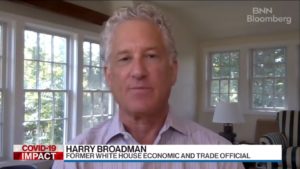
U.S. President Trump has threatened a 100% tariff hike on Chinese goods, and Harry Broadman, former US Assistant Trade Representative and Chief of Staff of the President’s Council of Economic Advisers, tries to make sense out of both countries’ moves at Al Jazeera.
The lack of details in the Chinese side’s statement “suggests that China is taking time to negotiate when U.S. is keen to have deals,” said Winston Ma, adjunct professor at NYU School of Law, pointing out that Beijing “said nothing about [an] APEC meeting.”
That contrasts with the constant flow of details from the U.S., now covering everything from investors to board seats. A Politico report, citing an unnamed senior White House official, even claimed that the Trump administration is “100% confident” of a deal forcing Beijing-based ByteDance to spin off TikTok’s U.S. operations.
Trump, however, may have preempted China’s coolness, saying in a Truth Social post Friday that he “appreciate[s] the TikTok approval” after his call with Xi, even as Beijing kept its language vague.
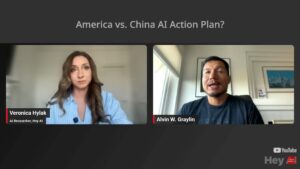
Alvin Wang Graylin, author of Our Next Reality: Preparing for the AI-powered Metaverse, worked in both the US and China on AI and compares the strategy of both countries. While China focuses on a multipolar approach, with mainly economic targets, the US does the opposite and looks at military strategies, he tells Veronica Hylak at Hey AI.
US retailer Target ended its promise to its consumers to get the lowest price. But under pressure of the inflation, triggered off by the trade war with China, and other challenges, Target has changed its long-standing business model. It is the end of a safety net for consumers, says retail analyst Ashley Dudarenokin Time.
Time:
Ashley Dudarenok, who runs a China- and Hong Kong-based consumer research consultancy, said the decision “eliminates a safety net for consumers” who could be sure that they were getting the most competitive prices at Target. “For consumers, this means the onus is now on them to compare prices before shopping, potentially pushing the most price-sensitive shoppers to competitors like Walmart or Amazon for certain purchases.”
Dudarenok says that Target is hoping its “loyal customer base, often attracted by the in-store experience and exclusive brands (the ‘Tar-jay’ effect) will absorb this change.” But the move is risky, she adds, at a time when U.S. consumer spending is falling.
Target has grappled with a slump in sales this year, with the company missing its Q1 revenue estimate and cutting its full-year sales outlook in May…
President Trump signed an executive order on Jan. 20 decrying DEI as “illegal and immoral discrimination” and ending federal initiatives. The order does not force private employers to abolish DEI programs but opens up companies to anti-DEI backlash.
“The company is juggling significant financial pressures, including the looming threat of tariffs on Chinese goods, with the need to maintain customer loyalty,” Dudarenok says. “Ending the price match policy is a defensive financial move. At the same time, the company is still navigating the fallout from its DEI initiatives, trying to find a neutral ground that doesn’t alienate its diverse customer base.”
Target’s challenges date back several years. The company’s annual revenue has stagnated since 2021, while its shares have fallen around 60% in that time.
Both China and the USA claim to want to negotiate a trade deal, but, according to economist Arthur Kroeber, author of China’s Economy: What Everyone Needs to Know®, since there is no common agenda, only common mistrust, it appears very unlikely that these talks will progress. He says this in an interview at Dwarkesh Clips.
U.S. President Donald Trump may be enthusiastic about the trade deal between China and the U.S., which was closed in London this week. However, business analyst Shaun Rein points out that the deal is lacking crucial details and might not work, as he notes in The Economic Times. “So, the economy in China is not booming, but China is not going to blink. They have the resolve to push hard back against Trump,” he adds.
Shaun Rein:
Trump is saying the deal has been signed and he has been talking about that the Chinese are going to send rare earths and magnets in advance to whatever the United States needs because what you have seen in the last month is the lack of rare earths that were exported to the United States has really crippled the American economy.
You can have companies, the big automakers like Ford and GM are rumoured to say, we need to relocate our manufacturing to China, so we can get access to rare earths despite the heavy tariffs that they would then incur by going into the United States. But here is the thing, China’s media has been a lot more circumspect with the details of this so-called trade agreement.
China has said the rumour is that they will give maybe export licenses to rare earths on a six-month trial basis to American companies. So, basically Trump is exaggerating the win in his mind and China is being a lot more honest probably saying well we do not have all the details ironed out, we want to come to an agreement but quite frankly China has the upper hand in the trade war with the United States right now…
The United States needs a deal. Frankly, China controls about 30-35% of global manufacturing. So, America might have the money, they might have the capital, but they need to buy the products from China. At the end of the day, China makes not just rare earths, about 90% of refined rare earths, but they also make most of the ibuprofen, most of the Tylenol.
Most of the antibiotics in the world comes from China. So, at the end of the day, that is real leverage. So, for instance in 2017, 18% of Chinese exports went to the US, that number is down to 14%. China on the other hand has shifted and exports to Asean, has gone up to 16%.
So, basically, it is a game of chicken right now. China’s economy is hurting, do not get me wg. There are about 15 million people who are involved in the export sector. You have seen that the CPI index has dropped about 0.1%. So, we are dealing with the D-word, deflation.
So, the economy in China is not booming, but China is not going to blink. They have the resolve to push hard back against Trump and Scott Bessent and Howard Lutnick because at the end of the day, the Americans need to buy from China. They cannot buy antibiotics from any other country in the world except for a little bit from India.
The Trump administration is pretty clueless on China, and that is only one of many issues when both countries are going to deal with each other, says leading economist Arthur Kroeber, author of China’s Economy: What Everyone Needs to Know, in an interview with the Australian broadcaster ABC. Both can inflict huge damage on each other, but neither is in a position to win a full-blown trade war, he adds.
For a week, US President Trump has been speculating on how a call with his Chinese counterpart, Xi Jinping, will solve their trade issues. Harry Broadman, a former US trade representative, explains in Politico why Trump is wrong.
Politico:
Trump’s expectation that a call with Xi can reboot U.S.-China trade talks on those issues and render substantive results defies the diplomatic and policymaking protocols of China’s ruling Chinese Communist Party.
“Trump is a deal maker. Xi Jinping is not a deal maker — he’s a Party guy at the top of an administrative superstructure,” said Harry Broadman, a former assistant U.S. trade representative in the George H.W. Bush and Bill Clinton administrations. “I cannot imagine that Xi would get into specifics — at most they might agree on certain principles but that’s not likely to satisfy Trump.”
There’s also a risk that a call between the two leaders could backfire for Trump by undermining longer term trade negotiations with China.
China is having the upper hand in the trade war with Trump and can replace almost every product it purchases from the US with products from other countries, with the exception, perhaps, of semiconductors, says Shaun Rein, a Shanghai-based political analyst and author of The Split: Finding the Opportunities in China’s Economy in the New World Order, at CNBC. China might push back harder than the US or Europe might be thinking, he adds.
Business analyst Shaun Rein, based in Shanghai, is more bullish on China’s economy than he has been since 2019, he says at CNBC. Especially now that China is winning the trade war, he adds.