Weblog with daily updates of the news on a frugal, fair and beautiful China, from the perspective of internet entrepreneur, new media advisor and president of the China Speakers Bureau Fons Tuinstra
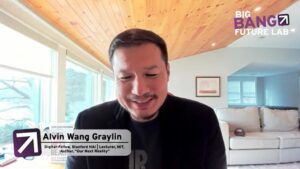
For years, the growth of AI was built on scaling up its GPUs, but innovation expert Alvin Wang Graylin, author of Our Next Reality: Preparing for the AI-powered Metaverse, sees now a move to more collaboration. Chip maker Nvidia is not the only winner anymore, as competition is growing and AI models can develop through more experience and need less capacity to grow, as China’s Deepseek proved earlier this year, he says at the Big Bang Future Lab.
Technically, the trade talks between China and the US, and even meetings between Xi and Trump, are on the agenda, but the US has quietly curtailed US exports to China in September, says business analyst Arthur Kroeberin the South China Morning Post. The ramifications of the US rule change became vividly apparent on September 30, when the Dutch government seized control of the chip firm Nexperia.
South China Morning Post:
Until recently, US exporters had to obtain a government licence to do business with any of the entities included on the lists. But in late September, the bureau broadened its rules: exporters now face restrictions not only when dealing with entities on the lists, but also with any company at least 50 per cent owned by entities on the lists.
US officials “depict this as a technical move” that closes an obvious loophole, but in reality “its impact is far from technical”, said Arthur Kroeber, partner and head of research at research firm Gavekal, in a research note published last week.
In practice, the new rules effectively expand the number of sanctioned companies, “probably by thousands or tens of thousands”, Kroeber said. Many of the companies affected by the rule change are Chinese.
What’s more, the new rules create an onerous compliance burden for businesses, as the responsibility for figuring out whether a given company is majority-owned by entities on the blacklists lies with US exporters. That means businesses must now conduct forensic due diligence on the ownership structure of many customers, Kroeber said.
The ramifications of the US rule change became vividly apparent on September 30, when the Dutch government seized control of the chip firm Nexperia.
Nexperia is a local company that in 2019 became majority owned by Wingtech, a Chinese chip firm that was put on the US entity list in 2021.
As Nexperia would be vulnerable to US sanctions under the new rules, the Dutch government’s move to take over the company and oust its Chinese CEO was necessary to preserve the firm’s unfettered access to the US market, Kroeber said.
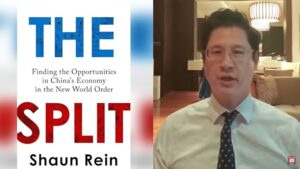
Business analyst Shaun Rein looks at the nervewracking few weeks for the global IT industry, starting with the DeekSeek moment of fame, proving that China was way ahead of the US competition in AI. Also, TikTok, Trump’s curtailing of Nvidia, RedNote’s success, censorship in the US, and Silicon Valley get his verdict on East-West Investment opportunities.
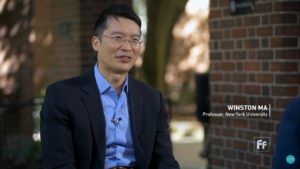
The world was in awe when Nvidia emerged as a giant in the stock markets, but the AI industry is still waiting for a real shake-out as it is still lacking a real killer app, says Winston Ma, adjunct professor at the NYU School of Law, in a comment at Forbes.
Forbes:
The market is betting on a much bigger story than generative AI itself: Maybe the AI boom will be the key critical catalyst for the ultimate digital transformation of all industries and economies, explains Winston Ma, adjunct professor at the NYU School of Law. “Then the demand for Nvidia chips will explode exponentially. The jury is still out because the market is searching for AI killer apps. 2024-2025 would be the years of AI implementation. The real test for Nvidia has just begun.”