Weblog with daily updates of the news on a frugal, fair and beautiful China, from the perspective of internet entrepreneur, new media advisor and president of the China Speakers Bureau Fons Tuinstra
Today, Mr. Xi’s top priority economic strategy is to promote Chinese advanced, high-tech manufacturing, and he is pouring massive government investment into this task. In 2019 alone, China spent an estimated equivalent of 1.7% of its gross domestic product on industrial policy – four times that of the U.S., according to a CSIS study.
Such investments have led to successful Chinese innovation in key industries such as electric vehicles, and green energy transition products such as solar power equipment and lithium-ion batteries.
This dominance serves China’s goal to create a dense web of bilateral trade and investment ties that bolster its wealth and influence, while maintaining China as a fortress of industrial and technological self-sufficiency, says Arthur Kroeber, head of research at the financial services company Gavekal and author of “China’s Economy: What Everyone Needs To Know.”
“They want to have leverage over the rest of the world, which they think is best achieved through very deep economic ties,” he says. “If countries have a lot of eggs in the China basket, it’s less easy for them to rely on the U.S.”
China’s retaliation against Mr. Trump’s tariffs last Friday – imposing 34% in additional tariffs on all imports from the U.S., starting April 10 – shows that Beijing is calling Mr. Trump’s bluff, he says. After the first U.S.-China trade war launched by Mr. Trump in 2018, Beijing spent years fortifying itself against U.S. pressure and developing various retaliatory tools.
“The government believes China can sustain the pain longer than the U.S. consumer can … and the U.S. will cave first,” he says. As a result, in Beijing the plan is not to let Mr. Trump dictate the terms with his off-and-on tariffs.
“If you are China,” he asks, “do you have to play that game?”
Beijing may consider more drastic steps, such as devaluing its currency to make its exports cheaper, says Mr. Kroeber. Indeed, on Tuesday China’s central bank set its reference rate for the Chinese yuan at the lowest level since September 2023 – a move considered a warning signal to Washington.
Beijing’s propaganda apparatus is working overtime to signal resolve.
Who will be winning the race in innovation, China or the US? Marketing expert Ashley Dudarenok expects China will have advantages, not only with Deepseek playing its way into AI development but also for robotics to NEVs, quantum computing, and eVTOL she explains at the Jing Daily.
Ashley Dudarenok:
From AI and robotics to NEVs, quantum computing and eVTOL, the country is setting the pace for global advancements. These developments reflect a broader vision to transition from being the “Factory of the World” to the “R&D Center of the World.” For businesses, the opportunities are vast, but so are the challenges. Success will depend on the ability to adapt, forge meaningful collaborations, and stay ahead in a rapidly evolving market. As China continues to shape the future of technology, the question is not whether to engage, but how to do so effectively and safely.
Ashley Dudarenok is a speaker at the China Speakers Bureau. Do you need her at your meeting or conference? Get in touch or fill out our speakers’ request form.
Are you looking for more innovation experts at the China Speakers Bureau? Do check out this list.
China can and will use its financial tools to offset the negative effects of the massive tariffs US President Trump has imposed on Chinese goods, says financial expert Winston Ma, adjunct professor at the New York University in a discussion with Bloomberg. China has not been using financial stimuli during and after the Covid crisis unlike the US, and still has the resources to do so now, he says.
The number of billionaires has increased more in the US compared to China for the first time in ten years, according to the latest 14th annual Hurun Global Rich List, according to Barrons. “It’s been a tough year for luxury, telecommunications, and real estate in China”, writes Rupert Hoogewerf, chairman and chief researcher of the Hurun Report.
Barrons:
The number of U.S. billionaires in the world reached 870 in mid-January, outpacing the number in China for the first time in 10 years, according to a snapshot of the wealthiest in the world by the Hurun Report.
The U.S. gained 70 billionaires since last year, powered by a rising stock market, a strong dollar, and the insatiable appetite for all things AI, according to the 14th annual Hurun Global Rich List. China gained nine billionaires overall for a total of 823. Hurun is a China-based research, media, and investment group.
“It’s been a good year for AI, money managers, entertainment, and crypto,” Rupert Hoogewerf, chairman and chief researcher of the Hurun Report, said in a news release. “It’s been a tough year for luxury, telecommunications, and real estate in China.”
Overall, the Hurun list—which reflects a snapshot of global wealth based on calculations made Jan. 15—counted 3,442 billionaires in the world, up 5%, or 163, from a year ago. Their total wealth rose 13% to just under $17 trillion…
The overall list this year contained 387 new billionaires, while 177 dropped off the list—more than 80 of which were from China, Hurun said. “China’s economy is continuing to restructure, with the drop-offs coming from a weeding out of healthcare and new energy and traditional manufacturing, as well as real estate,” Hoogewerf said in the release.
Among those who wealth sank was Colin Huang, the founder of PDD Holdings —the parent company of e-commerce platforms Temu and Pinduoduo—who lost $17 billion.
Also, Zhong Shanshan, the founder and chair of the Nongfu Spring beverage company and the majority owner of Beijing Wantai Biological Pharmacy Enterprise, lost $8 billion from “intensifying competition” in the market for bottled water. The loss knocked Zhong from his top rank in China, which is now held by Zhang Yiming founder of Tik-Tok owner Bytedance. Zhang is ranked No. 22 overall.
Much attention goes to industrial innovation to save China’s sluggish economy. But leading economist Arthur Kroeber, author of China’s Economy: What Everyone Needs to Know®, is not too sure that path is helping the economy, he tells at NPR. “Growth is probably going to be pretty sluggish for a few more years yet. And they’re not going to get this magical nirvana that they hope for,” he adds
NPR:
WOODS: But the strategy may have its limitations, according to Arthur Kroeber. Arthur is one of these long-time China heads. He’s written a book. He started a China macroeconomics firm. He divides his time between New York and Beijing. He says that the government’s theory seems to be that heavy investments in tech will lead to productivity breakthroughs. Those productivity breakthroughs will then lead to higher wages and good jobs
ARTHUR KROEBER: I don’t think that that is very likely, because the problem with that is you look at all these high-tech industries that everyone is so excited about, EVs and batteries and whatnot, but they’re not very profitable.
RUWITCH: Arthur says there’s a capacity glut, a lot of stuff being produced, but not enough buyers to keep businesses standing on their own two feet. Companies in the solar sector are struggling. In batteries, profits are falling. Profitability in EVs is dropping. And a lot of this is due to competition with other companies in China.
KROEBER: Everyone is struggling, so they’re all barely making money. And so they don’t have a lot of ability to hire lots of people and give them big wages.
WOODS: Without those big wage increases, Arthur says, it’s hard to see how growth in high-tech industries will spill over to the rest of the economy.
RUWITCH: He says China’s industrial policy has been successful at a certain level.
KROEBER: They’ve got a lot of very competitive manufacturing industries. But the– but growth is probably going to be pretty sluggish for a few more years yet. And they’re not going to get this magical nirvana that they hope for.
Traditional luxury markets have contracted, with the exception of travel, which is one of the conclusions of the 2025 Hurun Chinese Luxury Consumer Survey. “The average household consumption of China’s HNWIs was down 12% in the past year,” says Rupert Hoogewerf, chairman of Hurun, the research organization responsible for the Hurun Rich List in the Jing Daily.
The Jing Daily:
While travel flourishes, traditional luxury markets face headwinds. Hurun estimates that China’s luxury market contracted by 3% YoY, falling to $230 billion in 2024. High-end watches declined by 22%, luxury jewelry fell by 10%, and premium handbags dropped by 9%.
Meanwhile, luxury experiences thrive. The market for high-end services including hotels and travel grew 17% year-on-year.
“The average household consumption of China’s HNWIs was down 12% in the past year,” says Rupert Hoogewerf, chairman of Hurun, the research organization responsible for the Hurun Rich List. “This has forced high-end brands to deliver higher quality for a lower price.”…
Beyond destination preferences, Chinese HNWIs increasingly seek specific travel themes. Historical sites (13%), sunshine beaches (12%), and luxury resorts (11%) comprise the top travel themes. Cultural tourism has seen strong growth, while “short-distance luxury travel” and “ocean cruises” have emerged as new categories of interest.
Today’s typical Chinese luxury consumer is 35 years old, with family assets of 47.5 million RMB ($6.55 million), and resides in a 270-square-meter home. They spend seven days monthly on business travel and expect financial freedom by age 46.
“The lifestyle, investment, and brand preferences of the luxury consumers in China has changed dramatically in the past 20 years,” Hoogewerf says. “Preferred travel destinations have shifted from Australia, France and the U.S. to the Maldives, Singapore and Dubai; preferred sports have shifted from golf to running.”
These evolving preferences not only reshape China’s luxury industry and market but carry significant implications for global luxury markets and travel destinations seeking to capture this influential consumer segment in 2025 and beyond.
One of the key factors causing global coffee prices to rise is the massive growth of consumption in China. Marketing expert Ashley Dudarenok explains how Chinese consumers took on the coffee market over the past decades, a growth that is now yet finished, despite the rising prices, she tells in her vlog.
China’s toy company Pop Mart has become an instant domestic and international success for a new generation of consumers. Marketing guru Ashley Dudarenok explains in Time how Pop Mart was able to read the hearts and minds of a new brand of consumers. Pop Mart understands those consumer needs, according to Dudarenok, and the Chinese domestic market lets companies “fail fast and succeed fast” to figure out what consumers really want.
Time:
Where Pop Mart distinguishes itself from both domestic and international competitors is in reading the mood of its consumers, Ashley Dudarenok, who runs a China and Hong Kong-based consumer research consultancy, tells TIME. Whether it’s rebelliousness, a desire to escape, or exhaustion from work or school, Pop Mart customers are buying more than just a toy, they’re buying a symbol of themselves…
Dudarenok, the consumer research consultant, sees Pop Mart’s global success as more than just an ebbing of stigma against Chinese manufacturing; instead it’s a direct result of the company’s ability to navigate and succeed in the Chinese market. “It’s not a surprise that this kind of company comes out of China,” says Dudarenok. That’s because “China is the world’s most competitive digital market, with maybe the most spoiled consumer in the world that wants things fast, cheap, and good.” Pop Mart understands those consumer needs, according to Dudarenok, and the Chinese domestic market lets companies “fail fast and succeed fast” to figure out what consumers really want.
One way Pop Mart distinguishes itself from Japanese competitors is through its stores. By contrast, Dreams Inc. largely sells its toys online or through distributors like Kiddy Land, Kinokuniya, and Urban Outfitters. Pop Mart, on the other hand, turns its own stores into an experience—with each modeled after one of its characters—fuelling customers like Carillo and Leow to plan travels around visiting different Pop Mart stores. They’ve also capitalized on the blind box craze through their roboshops vending machines that make buying their blind boxes all the more accessible.
William Bao Bean (right), interviewed by Ashley Dudarenok
Global VC William Bao Bean, Managing General Partner at Orbit Startups, tells how the lessons learned in China helped him now to invest in emerging markets, and how he moved 2018 from China into those emerging markets. In a wide-ranging interview with marketing guru Ashley Dudarenok.
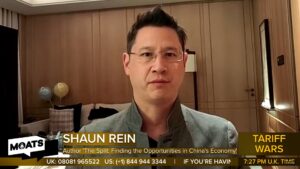
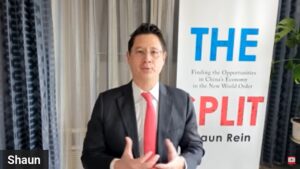
Shanghai-based business analyst Shaun Rein, author of The Split: Finding the Opportunities in China’s Economy in the New World Order, looks at what Western media miss when they report about China in a wide-ranging discussion with Cyrus Janssen. They wrongly assume China is unstable and often miss the essence of what happens in the country. For example, when the government cracked down on Alibaba founder Jack Ma. What that was about was not a political struggle, but an effort to create a level playing field, where the larger IT companies did not dominate the market anymore, Rein says.
China’s 310 million retirees (60 and over) are embracing technology, wellness, and premium experiences. Unlike previous generations, they prioritize health and longevity, driving demand for fitness devices, dietary supplements, and digital health platforms.
They are increasingly tech-savvy, using e-commerce platforms and mobile payments. Trust is paramount, so brands must focus on transparency, high-quality assurance, and personalized services. Retirees are also fueling China’s pet economy, treating animals as family and spending heavily on premium pet care.
Travel and leisure remain high on their list, with a focus on wellness retreats and historical tourism. Messaging that emphasizes active aging, intergenerational connections, and user-friendly technology will resonate. Brands should simplify digital interfaces, invest in trust-building, and highlight community engagement.
Tariffs and sanctions on China are not going to help the US, says Shanghai-based business analyst Shaun Rein. Only fair competition can help, certainly not when it comes to AI, he argues in The Rise of Asia.
Shaun Rein is a speaker at the China Speakers Bureau. Would you like him at your meeting or conference? Contact us or fill out our speakers’ request form.
Are you looking for more strategic experts at the China Speakers Bureau? Do check out this list.
Born between 1981 and 1996, China’s 320 million millennials are digital natives and major economic drivers. Their focus has shifted from affordability and status symbols to quality and sustainability. Eco-consciousness is now a purchasing prerequisite, with electric vehicles, smart home devices, and biodegradable packaging in high demand.
Millennials research extensively before buying, favoring platforms like JD.com and Taobao. Social media and green influencers play a crucial role in their choices. Brands that clearly communicate sustainability initiatives — such as carbon offset programs and ethical sourcing — gain their trust. However, greenwashing can damage brand credibility.
Luxury brands must integrate sustainability into their identity, providing tangible proof of commitment. Millennials are willing to pay for experiences that align with their values, such as eco-tourism and farm-to-table dining. By aligning with this mindset, brands can build long-term loyalty.
 China might have the upper hand in dealing with the US president’s efforts to curtail the country’s economy with sky-high tariffs, suggests leading economist Arthur Kroeber, author of China’s Economy: What Everyone Needs to Know®, in the Christian Science Monitor. “The government believes China can sustain the pain longer than the U.S. consumer can … and the U.S. will cave first,” he says.










 Tariffs and sanctions on China are not going to help the US, says Shanghai-based business analyst