Weblog with daily updates of the news on a frugal, fair and beautiful China, from the perspective of internet entrepreneur, new media advisor and president of the China Speakers Bureau Fons Tuinstra
Already in early 2025, China watcher Kaiser Kuo predicted Western leaders would change their view on how to deal with China and Xi Jinping. In a discussion on Novara Media, those Western leaders are queuing up to go to Beijing to restore relations they just a few years ago warned against. And where does Donald Trump fit into that change?
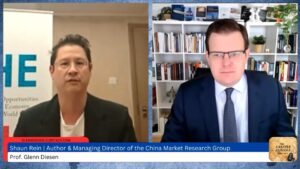
Stagnation is one of China’s economic key issues, but most China experts miss what is really going on because they left the country a decade ago, says Shanghai-based business analyst Shaun Rein to Glenn Diesen, author of “The Split: Finding the Opportunities in China’s Economy in the New World Order”. Unlike the previous financial crisis, the Chinese are sitting on a load of money and they are not in panic, but also do not spend their resources.
The rest of the world looks with interest at the assumed friendship between China and Russia. Still, that relation is not as close as many believe, says author Zhang Lijia in an analysis in the South China Morning Post. The powerplay is way more important than the assumed friendship, she writes.
Zhang Lijia:
But a leaked memo, reportedly from Russia’s Federal Security Service (FSB) tells a more sobering story – one of deep mistrust, strategic anxiety and growing alarm over China’s rise. The document describes China as a potential threat, even an enemy. It outlines fears of Chinese espionage, economic encroachment and cultural infiltration – especially regarding Chinese technology and creeping irredentism over former Qing territories like Vladivostok.
The memo – assessed as authentic by Western intelligence agencies – lifts the curtain on a relationship that is far more fragile than official statements suggest. As historian Sören Urbansky, an expert on Sino-Russian relations at Ruhr University Bochum in Germany, told me: “China and Russia are not natural allies, but strategic partners brought together primarily by their shared opposition to the West, rather than by trust or deep mutual affinity.”
This underlying mistrust, particularly within Russian security circles, doesn’t surprise those who closely follow the relationship – myself included.
The jury is still out on whether Trump’s tariffs on imports from China will hurt the US or China more. But political analyst Victor Shih has seen how China has been anticipating the latest wave of tariffs, he tells CNN. “But China can sustain that (situation) much more so than American politicians can,” he said.
CNN:
In China, a wide swath of suppliers are likely to see their already narrow margins completely erased, with a new wave of efforts to establish factories in other countries set to begin.
The scale of the tariffs could lead to “millions of people becoming unemployed” and a “wave of bankruptcy” across China, according to Victor Shih, director of the University of California San Diego’s 21st Century China Center. Meanwhile, US exports to China could “go close to zero,” he added.
“But China can sustain that (situation) much more so than American politicians can,” he said.
That’s, in part, because China’s ruling Communist Party leaders do not face swift feedback from voters and opinions polls.
“During Covid they shut down the economy (causing) untold employment, suffering – no problem.”…
Beijing in recent weeks has also been talking to countries from Europe to Southeast Asia in a bid to expand trade cooperation – and one up the US by winning over American allies and partners exasperated by the on-again-off-again trade war.
But it’s been bracing for US trade frictions since Trump’s first trade war and his campaign against Chinese tech champion Huawei, which were a wake-up call to Beijing that its economic rise could be derailed if it wasn’t prepared.
“The Chinese government have been preparing for this day for six years – they knew this was a possibility,” said Shih in Caornia, who added that Beijing had supported countries to diversify supply chains and looked to manage some of its domestic economic challenges in preparation, among other efforts.
Today, China is much better placed to weather a broader trade conflict, experts say. Compared with 2018, it’s expanded its trade relations with the rest of the world, reducing the share of US exports from roughly one-fifth of its total to less than 15%.
The international march forward of China’s EV producers profoundly influences the supply chains. China veteran Kaiser Kuo looks at the World Economic Forum in Davos, especially at CATL, the market leader for batteries in China, and a magnet for geopolitical tensions, he writes at the WEForum.
Kaiser Kuo:
China’s rise as a superpower in the electric vehicle (EV) industry has reshaped global supply chains, and at the centre of this transformation is Contemporary Amperex Technology Co. Ltd. (CATL). As the world’s largest EV battery maker, CATL has become a critical player in the clean energy transition – and a lightning rod for geopolitical tensions. Co-chairman and co-founder Pan Jian of CATL, speaking recently at the World Economic Forum Annual Meeting in Davos, underscored the global nature of the EV revolution: “It’s not going to be a one-country effort in terms of EVs. It’s going to be a global effort.”…
The road ahead for CATL is strewn with obstacles. The Trump administration’s tariffs on Chinese EVs and proposed bans on Chinese software – the very thing Pan credits for China’s edge in EVs – in US-sold vehicles are likely to complicate CATL’s operations. Furthermore, the Pentagon’s designation could deter US automakers from deepening partnerships with CATL, despite the company’s importance to their supply chains.
Yet CATL’s leadership remains confident. Pan’s optimism reflects a broader belief in the inevitability of EVs and the necessity of global collaboration. “It’s a massive cultural shift,” he said, referring to the transformation of the auto industry, “but it’s going to happen.”
As the EV revolution accelerates, CATL’s ability to navigate these geopolitical and market complexities will shape not only its future, but also the contours of the global energy transition. Its story is emblematic of a world grappling with the contradictions of competition, cooperation and the urgent need for sustainability.
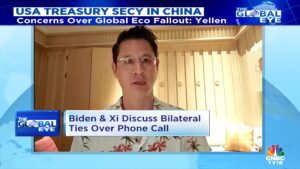
The USA is dealing with huge problems and cannot afford to challenge China directly, but decided to stabilize the relations between both countries, says Shanghai-based business analyst Shaun Rein to CNBC-TV18. But the USA is for sure keeping economic pressure going, he adds.
Political analyst Victor Shih breaks down the relations between China, the US, and the rest of the world in a discussion from the Chevron Auditorium in the I-House on “China-US Futures: Pathways to Peaceful Coexistence”. Key takeaways: many problems perceived by American politicians with China are not as bad as they try to let us believe.
Behind all the geopolitical shuffles between China and the US, the war on AI and the metaverse is raging, says AI expert Alvin Wang Graylin in an interview with Cyrus Janssen. And that is a wrong signal for the rest of the world, as both forces should not try to contain the other, for national security reasons or whatever, but work together, he argues.
Relations between China and Japan have been tense since the end of World War II, and the annual remembrance of the rape of Nanking, this year 86 years ago, marks those tensions. Author Zhang Lijia argues that nowadays both countries need better relations, she argues in the South China Morning Post. “An amicable Sino-Japanese relationship is vital for regional stability and prosperity. If the two remain hostile, it will play into the US’ hands,” she writes.
The South China Morning Post:
Back in the 1990s, plenty of Japanese politicians would have liked to befriend China as they saw that their future was in Asia. Beijing’s hostility, however, pushed them to embrace America wholeheartedly.
It’s time for Beijing to walk out of the past and forge closer ties with Tokyo. Beyond the fact that China is Japan’s largest trading partner, it has many reasons to be on good terms with this neighbour. As an Asian country with a long history with China, Japan can potentially play a role in softening crises, such as over Taiwan.
Reduced tensions would lessen the overall threat perception and allow a relaxation of all actors’ security positions in the region. An amicable Sino-Japanese relationship is vital for regional stability and prosperity. If the two remain hostile, it will play into the US’ hands…
I am not suggesting that Chinese people should forget the pain we suffered at the hands of the imperial Japanese. I, for one, shall not forget. As a Nanjing native, I still remember the harrowing stories my grandma told me. Back in 1937, as she tried to flee the city, her infant daughter in her arms, a bomb fell nearby. A neighbour only metres away disappeared, blown to pieces by the blast.
Tokyo should apologise unequivocally and unreservedly for the atrocities committed in China and apologise specifically for the Rape of Nanking.
While it is understandable that so many Chinese feel resentful towards Japan, it is unwise to let this anti-Japan sentiment spiral out of control. National interests should come before personal feelings, and it is in China’s best interests to improve its relationship with Japan.
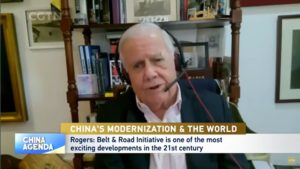
The US has 100 military bases outside its country in the world, while China is changing geopolitics by building railroads and highways, says renowned investor Jim Rogers in an interview with state-owned CGTN.