Weblog with daily updates of the news on a frugal, fair and beautiful China, from the perspective of internet entrepreneur, new media advisor and president of the China Speakers Bureau Fons Tuinstra
With three billion IOT (Internet Of Things) connections, China is leading this digital industry globally, says innovation expert Ashley Dudarenok at her vlog. “Supported by an impressive 11.9 million mobile stations, China has the infrastructure to dominate this space, she adds.
Economic and geopolitical pressure are changing the ways China’s KOLs are changing their strategies, says branding expert Ashley Dudarenokin the Jing Daily. “Amid these challenges, many KOLs are pivoting to create their own brands,” she writes.
Ashley Dudarenok:
Many KOLs, once commanding high fees, are now earning less as brands cut budgets in light of China’s slowing economy and weaker consumer spending.
With sales declining across many sectors, brands are increasingly moving toward fee-plus-commission arrangements, where KOLs earn a base fee supplemented by a percentage of sales generated through their promotions. While this results-driven model aligns with brands’ desire for measurable ROI, it has created significant challenges for influencers. When sales are low, KOLs see a substantial drop in income, making it harder for them to sustain their operations.
Amid these challenges, many KOLs are pivoting to create their own brands. Platforms like Xiaohongshu (RedNote) have become central to this trend, with influencers leveraging their loyal followings to sell their own products through livestreaming. This move offers greater independence and a more stable income, but also makes KOLs less inclined to promote external brands when they can prioritize their own products…
In 2025, you’d be hard-pressed to find a successful brand in China that does not have Key Opinion Employees (KOEs). These full-time employees not only work for a brand but also leverage their personal influence and credibility to promote the company’s products. KOEs engage in activities like livestreaming, sharing behind-the-scenes content, and showcasing their expertise, blending their professional role with their personal brand.
This approach offers brands a cost-effective way to build authenticity and trust, as consumers increasingly value real people over polished advertisements. KOEs also strengthen connections with audiences by presenting a relatable, human face behind the brand, making them a crucial element of modern marketing strategies in China. It’s no surprise, then, that brands often choose to invest more in KOEs when they can.
VC capital in China has dried up, but global VC William Bao Bean still sees opportunities for startups if they play their cards right, he says in an interview with Ashley Dudarenok. Most of the VC money did come from the government, and that capital is still available, although less through traditional VCs, he says.
Shaun Rein, an American Harvard graduate and managing director of the China Market Research Group (which is based in China), replied to Bessent’s comments: “China won’t fold to Trump and Bessent’s economic coercion – they hold the cards.”
Rein added, “In the United States, a lot of people think that China is nervous about the trade and it’s going to kneel down and fold and give in to all of Trump’s demands. That’s just not gonna happen.”
Rein added, “Right now, Xi Jinping and the Chinese people are coalescing, they’re not scared about the United States. They’re going to push back really hard.” He added, “They’re gonna push back a lot harder than Americans think.”
Harry Broadman, a former assistant U.S. trade representative in the administrations of George H.W. Bush and Bill Clinton, tells Politico that China proved to be much less of a pushover than the Trump team expected it to be when they started to impose tariffs. “Whoever is advising him clearly does not understand China.”
Politico:
Former high-level trade officials experienced with Chinese negotiation tactics said Trump’s expectation that Xi — like Mexico’s President Claudia Sheinbaum and now-former Canadian Prime Minister Justin Trudeau — would drop everything and pursue tariff relief was misplaced.
“Trump thought that China was a pushover and so he behaved like a New Yorker saying ‘let’s do a deal,’” said Harry Broadman, a former assistant U.S. trade representative in the George H.W. Bush and Bill Clinton administrations. “Whoever is advising him clearly does not understand China.”…
The Chinese government is willing to roll back tariffs on specific U.S. imports deemed essential to the Chinese economy, including pharmaceuticals, Reuters reported Friday. But it’s unclear whether Beijing is ready to broker a one-on-one meeting between Xi and Trump to fast-track wider tariff reductions and lay the groundwork for a new trade deal.
“They know Trump is in an untenable position and are letting the Energizer Bunny run down his batteries while they sit on the sidelines because they think they gain nothing by addressing him,” said Broadman. “Trump’s behavior is antithetical to the way they believe leaders should behave.”
B2B influencers are a key marketing tool in Asia, says Hong Kong-based marketing expert Ashley Dudarenok, but they are not enough on themselves, in Campaign Asia. “At its core, every B2B decision is made by people, not companies, and tapping into their emotions, challenges, and aspirations is key”, she says.
Campaign Asia:
Ashley Dudarenok didn’t intentionally set out to be a B2B influencer, but felt a strong need to educate and consult her B2B clients who were exploring opportunities in and with China. She started publishing insights on LinkedIn about eight years ago and has since grown her network to around 100,000 connections. She believes the ‘business to humans’ (B2H) approach is the most effective B2B influencer marketing strategy. “At its core, every B2B decision is made by people, not companies, and tapping into their emotions, challenges, and aspirations is key,” says Dudarenok. “Educate, don’t sell: B2B audiences respond to insights-driven, educational content that solves their problems. Influencers who focus on providing value rather than pushing products are the most effective.” But while B2B influencer marketing is effective when executed correctly, Dudarenok adds that it’s not sensible to rely on influencers only. “It might always be a smart strategy to build a KOE (key apportion employee), often the boss of the business who becomes a thought leader versus just paying someone else for promotions. Or do both. Do not rely on influencers only,” she advises… “At its core, every B2B decision is made by people, not companies, and tapping into their emotions, challenges, and aspirations is key” – Ashley Dudarenok, founder of ChoZan
While Trump has long accused China of ripping off the US on trade, analysts have questioned whether his administration has a clear goal of what it wants to achieve with its tariffs.
Harry Broadman, a former US assistant trade representative and one of the chief negotiators of the WTO, said it is not clear whether Trump wants to close the trade deficit with China or end business with the country outright.
“Markets are layered through the different stages of production, you’ve got components coming from all over the world. The global economy is finely chopped up vertically, so it’s not obvious who the winners and losers are.”
Broadman said Trump’s approach to trade has been simplistic and unrealistic.
“He’s obviously a deals guy in real estate, but not international markets … How he thinks is, ‘How can I win and how can I make the opponent lose?’” he said.
“It’s not more sophisticated than that. He’s not interested in splitting the spoils. But you don’t get very far with that.”
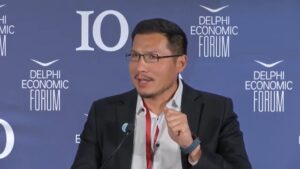
We see some dangerous signs AI is not going to benefit all, but potentially becomes a high risk tool, argues Alvin Wang Graylin, author of Our Next Reality: Preparing for the AI-powered Metaverse, at the Delphi Economic Forum earlier in April. We should all work together to prevent AI from being used as a weapon, he says.
China’s consumers, workers, and manufacturers look with relative confidence in their country’s position in the tariff war between the US and the rest of the world. Marketing expert Ashley Dudarenok looks at the social media, memes, comments, and other reactions of the Chinese, she tells at Time.
Time:
The AI-generated videos depicting Americans taking factory jobs, says Ashley Dudarenok, who runs a China and Hong Kong-based consumer research consultancy, relied on subverting a “long-standing stereotype about global labor dynamics.” And quickly, she tells TIME, the caricature was “absolutely everywhere, and it’s still trending.”
“There was the trade war, there was the tariff war, and now there is the meme war,” Dudarenok says.
Even among the Chinese workforce, more and more aspire to work in sectors other than manufacturing. Dudarenok says across Chinese social media she’s seen comments saying, “Chinese people don’t want to do these jobs, why would Americans want to do these jobs?” or “Chinese manufacturers are moving into Vietnam, into Africa—now we have another option: America.”
Still, the tariffs are no joke to those in China whose livelihoods depend on manufacturing goods for export. Some have also taken to social media to respond to the tariffs: by explaining how cheaply they actually manufacture goods and how much of the price consumers paid pre-tariffs came from brand markups…
Some have even appealed to Americans to buy directly from them. “They want to get rid of the middleman,” says Mei. But consumers should beware that claiming to manufacture for big brands while actually producing knock-offs is a common scam, and some scammers could be exploiting consumer panic about potential price hikes. While China produces more than half of the world’s clothing and textiles, Dudarenok says manufacturers that are “trusted partners” with big brands don’t typically sell their partners out so easily. ..
The government’s message is clear, Dudarenok says: “China is prepared to fight for its right to be in the room and to be at the table.”
The jury is still out on whether Trump’s tariffs on imports from China will hurt the US or China more. But political analyst Victor Shih has seen how China has been anticipating the latest wave of tariffs, he tells CNN. “But China can sustain that (situation) much more so than American politicians can,” he said.
CNN:
In China, a wide swath of suppliers are likely to see their already narrow margins completely erased, with a new wave of efforts to establish factories in other countries set to begin.
The scale of the tariffs could lead to “millions of people becoming unemployed” and a “wave of bankruptcy” across China, according to Victor Shih, director of the University of California San Diego’s 21st Century China Center. Meanwhile, US exports to China could “go close to zero,” he added.
“But China can sustain that (situation) much more so than American politicians can,” he said.
That’s, in part, because China’s ruling Communist Party leaders do not face swift feedback from voters and opinions polls.
“During Covid they shut down the economy (causing) untold employment, suffering – no problem.”…
Beijing in recent weeks has also been talking to countries from Europe to Southeast Asia in a bid to expand trade cooperation – and one up the US by winning over American allies and partners exasperated by the on-again-off-again trade war.
But it’s been bracing for US trade frictions since Trump’s first trade war and his campaign against Chinese tech champion Huawei, which were a wake-up call to Beijing that its economic rise could be derailed if it wasn’t prepared.
“The Chinese government have been preparing for this day for six years – they knew this was a possibility,” said Shih in Caornia, who added that Beijing had supported countries to diversify supply chains and looked to manage some of its domestic economic challenges in preparation, among other efforts.
Today, China is much better placed to weather a broader trade conflict, experts say. Compared with 2018, it’s expanded its trade relations with the rest of the world, reducing the share of US exports from roughly one-fifth of its total to less than 15%.