Friday, August 22, 2025

Marriage in China loses its appeal – Zhang Lijia


The number of people avoiding marriage is growing dramatically in China, while the government hopes youngsters not only marry, but also give birth to children. But the change is more than about demographics only, says the journalist Zhang Lijia, author of “Socialism Is Great!”: A Worker’s Memoir of the New China in the Guardian.

The Guardian:

Some of this is because of China’s ageing population. Decades of the one-child policy, which was scrapped in 2016, forced the population into decline, meaning that the pool of people of marrying age has been shrinking.

But, analysts say, demographics alone don’t explain the trend.

“The deeper change is in attitudes,” said Lijia Zhang, a writer who is working on a book about marriage in China. “In the past, when the country was poor, marriage was an economic necessity … Now it’s about personal happiness, more than anything else, not filial duty or social obligation. Many urban, educated women no longer see marriage or motherhood as essential to a fulfilling life.”

Hao Jingyi, 19, agrees. “If I don’t meet someone suitable, I would enjoy more freedom and comfort living alone … women are increasingly disappointed with men these days,” she said,

More in the Guardian.

Zhang Lijia is a speaker at the China Speakers Bureau. Do you need her at your meeting or conference? Do get in touch or fill in our speakers’ request form.

Are you looking for more experts on cultural change at the China Speakers Bureau? Do check out this list.

Wednesday, August 13, 2025

Why China can walk away from a deal with the US – Arthur Kroeber


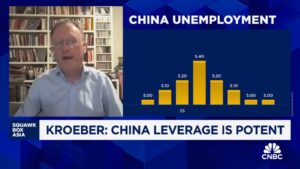
Leading economist Arthur Kroeber, author of China’s Economy: What Everyone Needs to Know®, explains at CNBC why China can walk away from a trade agreement with the US if they do not like it, although its economy is not very bright at this stage. He does not expect to see any great push to improve consumption or the economy at large, as the leadership is happy with the current modest growth.

Arthur Kroeber is a speaker at the China Speakers Bureau. Do you need him at your meeting or conference? Do get in touch or fill in our speakers’ request form.

Are you looking for more strategic experts at the China Speakers Bureau? Do check out this list.

Monday, August 04, 2025

How AI has entered the stage as filmmaker – Winston Ma


Winston ma

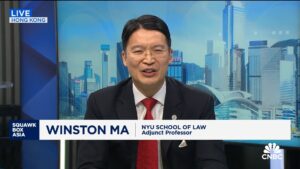
AI tools to generate videos, like TikTok, have been challenged by a new wave of innovations using AI as filmmakers, says Winston Ma, author of The Digital War: How China’s Tech Power Shapes the Future of AI, Blockchain and Cyberspace at CNBC. “Just like TikTok took the global markets by storm with short videos in the mobile internet age, Chinese AI companies could well lead the Generative AI revolution in visual digital entertainment,” said Ma.

CNBC:

Chinese e-commerce giant Alibaba has also stayed on top of the trend by releasing the latest version of its video generation AI model this week called Wan2.2. The company claimed that with the open-source model, users can control lighting, time of day, color tone, camera angle, frame size, composition and focal length.

Open source allows users to download a model for free, and customize, if not commercialize, products with it. Alibaba claimed that since open sourcing the “Wan” model series in February, the models have been downloaded more than 5.4 million times from the Hugging Face platform and a similar one in China called ModelScope.

“The age of AI in film is over. We’ve entered the age of AI as filmmaker,” said Winston Ma, adjunct professor at NYU School of Law. He pointed out that China’s 1.4 billion population has given local companies “enormous” amounts of video-watching data to work with.

“Just like TikTok took the global markets by storm with short videos in the mobile internet age, Chinese AI companies could well lead the Generative AI revolution in visual digital entertainment,” said Ma, author of “The Digital War: How China’s Tech Power Shapes the Future of AI, Blockchain and Cyberspace.”

More at CNBC.

Winston Ma is a speaker at the China Speakers Bureau. Do you need him at your meeting or conference? Email us or fill in our speakers’ request form.

Are you looking for more innovation experts at the China Speakers Bureau? Do check out this list.
Sunday, July 20, 2025

How the tariff war kills Target’s business model – Ashley Dudarenok


Ashley Dudarenok

US retailer Target ended its promise to its consumers to get the lowest price. But under pressure of the inflation, triggered off by the trade war with China, and other challenges, Target has changed its long-standing business model. It is the end of a safety net for consumers, says retail analyst Ashley Dudarenok in Time.

Time:

Ashley Dudarenok, who runs a China- and Hong Kong-based consumer research consultancy, said the decision “eliminates a safety net for consumers” who could be sure that they were getting the most competitive prices at Target. “For consumers, this means the onus is now on them to compare prices before shopping, potentially pushing the most price-sensitive shoppers to competitors like Walmart or Amazon for certain purchases.”

Dudarenok says that Target is hoping its “loyal customer base, often attracted by the in-store experience and exclusive brands (the ‘Tar-jay’ effect) will absorb this change.” But the move is risky, she adds, at a time when U.S. consumer spending is falling.

Target has grappled with a slump in sales this year, with the company missing its Q1 revenue estimate and cutting its full-year sales outlook in May…

Target has also struggled with consumer boycotts following its decision on Jan. 24 to roll back its diversity, equity, and inclusion (DEI) policies.

President Trump signed an executive order on Jan. 20 decrying DEI as “illegal and immoral discrimination” and ending federal initiatives. The order does not force private employers to abolish DEI programs but opens up companies to anti-DEI backlash.

“The company is juggling significant financial pressures, including the looming threat of tariffs on Chinese goods, with the need to maintain customer loyalty,” Dudarenok says. “Ending the price match policy is a defensive financial move. At the same time, the company is still navigating the fallout from its DEI initiatives, trying to find a neutral ground that doesn’t alienate its diverse customer base.”

Target’s challenges date back several years. The company’s annual revenue has stagnated since 2021, while its shares have fallen around 60% in that time.

More in Time.

Ashley Dudarenok is a speaker at the China Speakers Bureau. Do you need her at your meeting or conference? Do get in touch or fill in our speakers’ request form.

Are you looking for more branding experts? Do check out this list.

Monday, July 07, 2025

Why China and the USA are not heading for a Cold War 2.0 – Arthur Kroeber


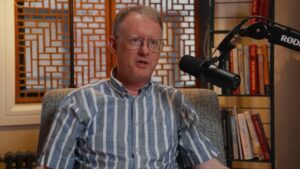
Arthur Kroeber

Many observers wrongly see the current trade war between China and the US as a Cold War 2.0, says political analyst Arthur Kroeber, author of China’s Economy: What Everyone Needs to Know® in an interview with Dwarkesh Patel. If American politicians started this war without seeing the difference from a cold war, it might be tough to bring it to an end, he adds.

Arthur Kroeber is a speaker at the China Speakers Bureau. Do you need him at our meeting or conference? Do get in touch or fill in our speakers’ request form.

Are you looking for more political analysts at the China Speakers Bureau? Do check out this list.

Get ready for two Dalai Lamas – Ian Johnson


Ian Johnson – China Speakers Bureau
Ian Johnson

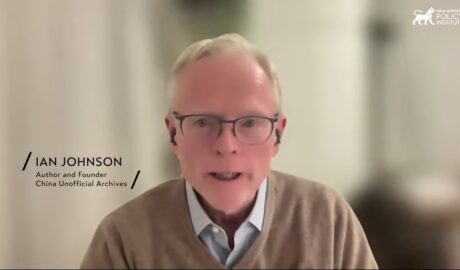
China’s government and Tibet’s spiritual leader, the Dalai Lama, are at loggerheads on what will happen when the latter dies, and a such for a new Dalai Lama will start. Get ready for two Dalai Lamas, predicts Ian Johnson, fellow at the Wissenschaftskolleg zu Berlin, and author of The Souls of China: The Return of Religion After Maoat the ChinaFile.

Ian Johnson:

China’s playbook for the Dalai Lama’s succession will be quite straightforward: Beijing will ignore everything that the current Dalai Lama says and try a rerun of the Panchen Lama succession in 1995, which worked out quite well for the authorities.

For those who don’t remember, the old Panchen Lama died in 1989, and in 1995 both the Chinese Communist Party (CCP) and the Dalai Lama camps anointed their own successors. Each one claimed tradition, with the Chinese Communist Party rolling out a series of largely invented customs about golden urns to say that it, as the successor to the Qing dynasty, was following what had gone on since time immemorial, or something to that effect.

Whatever the truth, the tactic ultimately worked in China’s favor: There are two Panchen Lamas, and the power of that position has been fragmented.

Fast forward to now: If Beijing can do the same thing, that’s a big win for the Party’s ethnic policy. Some Tibetans will follow the Dalai Lama approved by the exiles because he essentially will have the imprimatur of the current Dalai Lama. But others won’t be so sure. China controls information and some will celebrate the Beijing-approved Dalai Lama.

More importantly, the new Dalai Lama won’t be appointed right away. Typically, a few years pass before the reincarnated Dalai Lama is found. Even then, the new Dalai Lama will be a kindergartener—not exactly someone mind-melding with Richard Gere and penning profound tracts on life in the 21st century.

The reality is it will be 20 years before the new Dalai Lama can weigh in on public debates. By then, it’s not clear what will be left of Tibetan culture anyway, especially with China racing forward with efforts to eradicate the language.

More comments at the ChinaFile.

Ian Johnson is a speaker at the China Speakers Bureau. Do you need him at your meeting or conference? Do get in touch or fill in our speakers’ request form.

Are you looking for more political experts at the China Speakers Bureau? Do check out this list.

Why Legoland is winning the China consumer over, and Starbucks is losing it – Shaun Rein


Shaun Rein

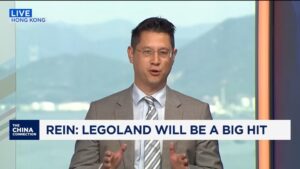
China’s consumers are dramatically changing their spending habits, says business analyst Shaun Rein at CNBC. They might not spend on EVs and real estate, but they are sitting on massive savings and will spend when they see the value. Why is Legoland winning the fight for the Chinese consumer, while Starbucks is losing it? Why do they enjoy holidays in mainland China, rather than Thailand or Europe?

Shaun Rein is a speaker at the China Speakers Bureau. Do you need him at your meeting or conference? Do get in touch or fill in our speakers’ request form.

 Are you looking for more consumption experts at the China Speakers Bureau? Do check out this list.

Made in China 2.0 – Kaiser Kuo


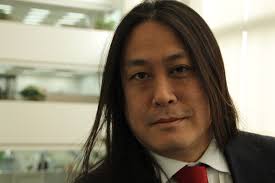
Kaiser Kuo

A decade ago, China launched its ambitious “Made in China 2025”. And while the phrase has disappeared, the industrial ambitious have no, writes China veteran Kaiser Kuo at the World Economic Forum. Today, that strategy appears to be entering a new phase — one we might call “Made in China 2.0,” he says.

Kaiser Kuo:

Launched a decade ago, “Made in China 2025” appeared to many as the emblem of China’s vaulting industrial ambitions: a state-driven roadmap to catapult the nation from the world’s factory floor to the apex of advanced manufacturing.

Though the slogan itself quietly vanished from official Chinese discourse under international scrutiny, the underlying agenda never did. Instead, its objectives evolved, were rebranded under banners like “dual circulation” and “high-quality development,” and ultimately seeped into the marrow of China’s industrial strategy.

Today, that strategy appears to be entering a new phase — one we might call “Made in China 2.0.” While it lacks a formal label, its contours are increasingly clear: an AI-augmented, green-energy-powered, self-reliance-oriented transformation of the world’s most formidable industrial base. In everything from electric vehicles and solar panels to humanoid robots and enterprise-grade AI systems, China is defining the terms of competition.

This transformation is unfolding amid profound global shifts. Fragmenting supply chains, rising techno-nationalism, and concerns over overcapacity have created a contested landscape for global manufacturing. Yet within that turbulent context, China has continued to expand its industrial and technological footprint. The question is no longer whether China can innovate, but what kind of innovation ecosystem it is building — and whether it might constitute an alternative paradigm to the liberal market model.

More at the World Economic Forum.

Kaiser Kuo is a speaker at the China Speakers Bureau. Do you need him at your meeting or conference? Do get in touch or fill in our speakers’ request form.

Are you looking for more strategic experts at the China Speakers Bureau? Do check out this list.

Friday, June 27, 2025

China’s corporate forces underlining its economic strength – Kaiser Kuo


Kaiser Kuo

China veteran Kaiser Kuo examines the ten Chinese companies, which are booming in China’s economy, despite the pressure it is under. Most names might be new to the non-Chinese, but these ten are worth putting on your China watch list, if they are not yet, he writes at the World Economic Forum: CATL (宁德时代), Envision Energy (远景能源), Haier (海尔集团), Huawei (华为), JinkoSolar (晶科能源), LONGi Green Energy Technology (隆基绿能科技股份有限公司), Meituan (美团), Pop Mart (泡泡玛特), Seres Group (赛力斯), Xiaohongshu (小红书 / RedNote),

Kaiser Kuo on Haier:

Status: Public (SSE: 600690), also listed in Hong Kong

Founded: 1984 by Zhang Ruimin

Headquarters: Qingdao, Shandong province

Main Businesses: Smart appliances, IoT, home automation solutions, digital factories

Why It Matters:
The oldest company on our list, Qingdao-based Haier revolutionized Chinese entrepreneurship — famously when its CEO used a sledgehammer to destroy a defective fridge in the year of its founding. In the 40 years since, it’s grown from a white goods company known mainly for its dormitory refrigerators into a global IoT appliance leader, integrating AI across its platforms and operating micro-factories in over 20 global markets while targeting zero-carbon operations.

What You Probably Didn’t Know:
Haier spun off nearly a dozen micro-factories: small, flexible production units focused on local demand and customization. In Qingdao, one “dark factory” — so-called because there’s no need for lights in this almost fully robotic operation — produces washing machines and fridges autonomously, with no more than three human overseers.

Think of it as…
GE Appliances meets Bosch’s precision engineering, with a dash of Netflix’s AI-driven personalization and modular, user-centric flair.

Nine more at the World Economic Forum.

Kaiser Kuo is a speaker at the China Speakers Bureau. Do you need him at your meeting or conference? Do get in touch or fill in our speakers’ request form.

Are you looking for more strategic experts at the China Speakers  Bureau? Do check out this list.

Wednesday, June 25, 2025

Why trade negotiations between China and the US will lead nowhere soon – Arthur Kroeber


Arthur Kroeber

Both China and the USA claim to want to negotiate a trade deal, but, according to economist Arthur Kroeber, author of China’s Economy: What Everyone Needs to Know®, since there is no common agenda, only common mistrust, it appears very unlikely that these talks will progress. He says this in an interview at Dwarkesh Clips.

Arthur Kroeber is a speaker at the China Speakers Bureau. Do you need him at your meeting or conference? Do get in touch or fill in our speakers’ request form.

Are you looking for more strategic experts at the China Speakers Bureau? Do check out this list.

How the state, market and academia move AI in the same direction – Kaiser Kuo


Kaiser Kuo

Technology veteran Kaiser Kuo explains how AI developments with DeepSeek, MiniMax, Moonshot AI, and iFlyTek emerged as winners in China’s technology scene. Especially, the coordination between the state, the market, and academia helps technology to move in the same direction, he adds at the World Economic Forum.

Kaiser Kuo:

One of the less visible but profoundly consequential enablers of China’s rapid advance in generative AI is the unusually tight coordination among its public sector institutions, academic research bodies and private firms. While this kind of alignment is sometimes viewed with suspicion outside of China, particularly when it is framed in terms of state-led industrial policy or state-backed enterprise, the practical effect has been to lower barriers between research and application, to accelerate funding decisions and to unify long-term technological goals across domains.

Consider how China’s most capable research universities — Tsinghua, Peking University, Shanghai Jiaotong, Zhejiang University — serve not only as training grounds for AI talent, but as intellectual incubators for commercial ventures. Many of the leading generative AI firms in China, including Zhipu AI and Baichuan, emerged directly from university research labs, often with seed funding from state-affiliated venture arms and built-in partnerships with municipal development zones or digital economy clusters.

State guidance funds, particularly those aligned with the “New Infrastructure” initiatives launched in the late 2010s, have prioritised compute infrastructure, AI chips and cloud services. These funds offer long-horizon capital to projects that would likely struggle to gain equivalent traction in private markets, particularly during periods of economic tightening or when returns on investment are uncertain. Yet at the same time, the market incentive remains intact. Leading Chinese AI startups face intense domestic competition from rivals like DeepSeek, MiniMax, Moonshot AI and iFlyTek, all of which operate in a fast-moving environment that rewards iterative gains and rapid deployment.

Much more at the World Economic Forum.

Kaiser Kuo is a speaker at the China Speakers Bureau. Do you need him at your meeting or conference? Do get in touch or fill in our speakers’ request form.

Are you looking for more strategy experts at the China Speakers Bureau? Do check out this list.

Pl

Monday, June 23, 2025

Why America fails to understand China – Arthur Kroeber


Arthur Kroeber

China now understands the US better than America understands China, argues economist Arthur Kroeber, author of China’s Economy: What Everyone Needs to Know®, in an interview at the Dwarkesh Clips. Both on a personal and a governmental level, America has stopped investing in good relations with China, he says.

Arthur Kroeber is a speaker at the China Speakers Bureau. Do you need him at your meeting or conference? Do get in touch or fill in our speakers’ request form.

Are you looking for more stories by Arthur Kroeber? Do check out this list.

Friday, June 20, 2025

How BYD crushed Tesla – Arthur Kroeber


Arthur Kroeber

BYD surprised everyone by successfully taking on Tesla. Economist Arthur Kroeber, author of China’s Economy: What Everyone Needs to Know®, explains how China’s approach allowed to take on Tesla and came out as a winner, he tells Dwarkesh Patel.

Arthur Kroeber is a speaker at the China Speakers Bureau. Do you need him at your meeting or conference? Do get in touch or fill in our speakers’ request form.

Are you looking for more strategic experts at the China Speakers Bureau? Do check out this list.

How China became rich in a 40-year transformation – Kaiser Kuo


Kaiser Kuo

How did China change from an economic laggard into a booming country? China veteran Kaiser Kuo dives into the country’s 40-year transformation for the World Economic Forum. For example, how it succeeded in becoming a digital giant.

Kaiser Kuo:

The Chinese leadership under Xi Jinping has as its current focus the development of “new quality productive forces.” What this means is that innovation will, it is hoped, become the main driver of growth, with an emphasis on quality growth over quantity or rapid expansion. This translates more concretely into a renewed emphasis on basic science, “hard” tech like new materials and semiconductors, artificial intelligence, supply chain efficiency and rationalization, and green and sustainable development.

Xi Jinping would like to see physicists doing physics, not designing sophisticated financial products or social media advertising algorithms. Whether these strategies will succeed in navigating China through its next phase of development remains an open question, but if China’s past record is any indication, one might reconsider betting against it.

Other developing countries might look to China’s experience for lessons, but the unique combination of historical context, cultural factors, and policy decisions that shaped China’s rise may not be easily replicable. When its own rhetoric speaks so often of “Chinese characteristics,” it may be less likely that China will seek to push its own developmental model, though doubtless some of its features will prove attractive. As China continues to evolve, the world will be watching closely to see how it addresses these challenges and what new pathways it charts for future growth.

Those challenges are numerous: Environmental degradation, rising labour costs, and an aging population pose significant hurdles. Maintaining the stability that has been so crucial for China thus far, while allowing for experimental approaches, improvisation, and creative thinking that will drive economic dynamism in the future will require careful balancing.

Much more at the World Economic Forum.

Kaiser Kuo is a speaker at the China Speakers Bureau. Do you need him at your meeting or conference? Do get in touch or fill in our speakers’ request form.

Are you looking for more strategic experts at the China Speakers Bureau? Do check out this list.