Weblog with daily updates of the news on a frugal, fair and beautiful China, from the perspective of internet entrepreneur, new media advisor and president of the China Speakers Bureau Fons Tuinstra
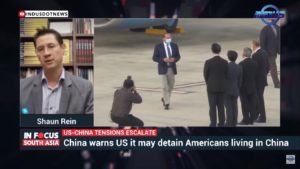
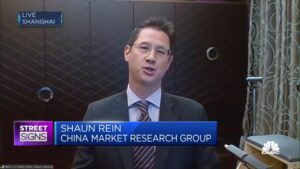
Some rumours suggest China will use the ongoing geopolitical tension to prepare for a takeover of Taiwan. Wrong, says Shanghai-based business analyst Shaun Rein, author of The Split: Finding the Opportunities in China’s Economy in the New World Order, in a wide-ranging podcast with Cyrus Janssen at the Singjup0st. “Every six months,” says Rein, “somebody hires me since the late 90s, saying, This is the perfect time for Taiwan to be invaded and taken over by mainland China.’ And so every six months for the last 29 years, I’ve been giving speeches, keynotes, workshop sessions, because I don’t think that’s going to happen anytime soon.”
The Singjupost:
SHAUN REIN: So for your audience who don’t know me, I’m actually American, but I’ve been in China for most of the last 29 years. And one of the ways that I’ve made a lot of money, Cyrus, frankly, is every six months, somebody hires me ever since the late 90s, saying, “This is the perfect time for Taiwan to be invaded and taken over by mainland China.” And so every six months for the last 29 years, I’ve been giving speeches, keynotes, workshop sessions, because I don’t think that’s going to happen anytime soon.
I remember in 2022, at the height of COVID, the Chinese economy was probably in a recession. Even though the official figures didn’t say that, people were miserable. That would have been a great time for the CPC to invade Taiwan to distract people from the overhang of COVID as well as from the weak economy.
There are a number of reasons why, Cyrus, that I don’t view a military invasion to be imminent. The first, and this is a little bit more touchy, but you got to remember there are nine people on the Central Military Commission. This is the highest military commission in China. Seven of the nine have been arrested or publicly investigated in the last year and a half for corruption. Now, I don’t know if it’s factional fighting or if it’s truly corruption. It could truly be corruption because the military was rotten to the core over the last several decades. But what it means is when you take out seven of the nine top military leaders and you only have two left, and one of them is Xi Jinping himself, who’s obviously not a military leader, I’m not sure that you have the military leadership in place to launch something like a Taiwan invasion. That’s the first point.
The second point is China, I think, likes to do more of a “buy by influence” approach. Now, what do I mean by this? In Xinjiang and Tibet, these two regions did have a lot of ethnic unrest 10, 15 years ago. We have to be honest about that. So what did China do? Well, they launched huge programs to build up the medical care sectors, to build up the education sectors and build up infrastructure. They invested billions, if not hundreds of billions of dollars into Tibet and Xinjiang. Essentially, their idea was make the life of these minorities better and gain the support from the elites in these regions to support the CPC. And it’s worked fantastically, as we’ve talked about in the past.
I’ve been to Tibet and Xinjiang three times, and probably the most optimistic consumers in China are actually the ethnic minorities, the Tibetans and the Uyghurs in these two provinces, because now they have a good quality of life.
Now, what has China done? They’ve done the same thing with Hong Kong. When they took over Hong Kong from the British in 1997, instead of calling it a governor, instead of calling it a mayor, they called the head of Hong Kong the chief executive, because they wanted to show the people of Hong Kong that they were pro business still. Now, here’s what China did — they gave the tycoons like Li Ka Shing, the Quok family, the Chung family, the best property locations in China and helped them make a lot of money. If you look at Huaihai Road or Wangfujing in Beijing, the best prime locations are all controlled by Hong Kong tycoons because basically China wanted to buy their support.
Now it was a lot harder to work in Hong Kong because Hong Kong per capita GDP is higher than mainland China’s, because there’s a lot of Christianity and Cardinal Zen, who was the Catholic cardinal there, was very anti-CPC and would be one of the harshest critics. So it was very hard to buy the support of the Hong Kong people, which is why you saw the protests in 2014 with the umbrella protests and then the terrorism and rioting in 2019.
So China now, though, has been slowly able to succeed in buying the support of Hong Kongers who’ve stayed in Hong Kong by integrating Hong Kong with Greater Bay. I’ve spent a lot of time in Hong Kong in the last six months and Stephen Roach was wrong, 100%. Hong Kong is not dead. It’s booming again. It was the largest IPO market in 2025. It’s electric because China was trying to help the people of Hong Kong through economic benefits.
So that was kind of a long winded answer. But let’s go back to Taiwan.
When it comes to Taiwan, Cyrus, I view that China is trying to give a lot of economic incentives to the people of Taiwan. So in Fujian Province, the province that’s closest to Taiwan, they’ve given housing, education and medical benefits to any Taiwanese compatriots who decide to move to Fujian.
Now, most importantly, you need to look at Taiwan’s political system, which is really divided into two — the DPP, who are currently in charge, and the current president has another five year term. But when you look at the KMT or the Guomindang, they actually have really good relations with the CPC right now. The new chairwoman of the KMT actually earlier this week said she would like to come and meet with Xi Jinping himself. The Vice Chairman of the KMT over the last couple of years has been to China and has been treated like a hero. And even more importantly, Cyrus, is President Ma — the former President of Taiwan — who has come into mainland China, been treated like a hero and met with Xi Jinping himself.
So it’s a long winded answer. But what I expect to happen is China is going to try to dole out more and more economic incentives to the Taiwanese to gain their support like they did in Tibet, Xinjiang, and starting to get in Hong Kong. And they’re going to wait and see. Will the KMT win the presidency in several years? Because then you might be able to get a one country, two systems integration in Taiwan if the KMT is in charge, in the same way that China was able to do it with Hong Kong.
At the end of the day, Cyrus, the Chinese are not warmongering like the Americans. They view that the Taiwanese are their cousins and they don’t want to see any death. So I’m not concerned. Now, you can ask me this in six months and I’m sure some investment banks will do that. And I’ll write that $50,000 check again for a keynote.
When you do not acknowledge your own history, the same mistakes can be made again, says Shanghai-based business analyst Shaun Rein, analysing the recent tensions between China and Japan. Japanese are rewriting history, he argues in the Thinkers Forum, from the hundreds of thousands of sex slaves in China and other parts of Asia, to today.
China veteran Kaiser Kuo of the Sinica Podcast moderates a discussion on how the US-China tension have an profound impact on the war in the Ukraine and the position of Taiwan at the Ukrainian platform for Contemporary China.
The speakers: Da Wei, Director of Center for International Security and Strategy; Professor at School of Social Sciences, Tsinghua University; Dmytro Burtsev, Junior Fellow at A. Krymskyi Institute of Oriental Studies, National Academy of Sciences of Ukraine; Emilian Kavalski, Professor at Centre for International Studies and Development, Jagiellonian University in Krakow; Yuan I, Research Fellow, Institute of International Relations, National Chengchi University, Taiwan.
Fast food giant McDonald’s is expanding its footprint in China with one-third of its planned 9,000 new restaurants. China is key for McDonald’s expansion, says Shanghai-based business analyst Shaun Rein in FDIntelligence. “McDonald’s actually has a lot of potential because it’s considered cheap, quick [and] convenient,” says Shaun Rein.
FDIntelligence:
McDonald’s expansion in China comes against a backdrop of a slowing domestic economy and rising geopolitical tensions.
“McDonald’s actually has a lot of potential because it’s considered cheap, quick [and] convenient,” says Shaun Rein, the managing director of China Market Research Group.
While foreign companies must be “cautious about entering China and getting caught up in the geopolitical fight”, Mr Rein adds this does not apply to brands like McDonald’s in “innocuous” sectors.
And yet, McDonald’s was a major symbol of the Western exodus from Russia after its invasion of Ukraine. This begs the question: does the fast food giant worry about the risk of China invading Taiwan?
Mr Rein says that many multinational corporations are reducing their investment into China out of fears over a war over Taiwan. “There would be political pressure to divest Chinese operations in the event of war, but my guess is there would be greater pushback from the business community than there was over Russia.”
Former Beijing correspondent Ian Johnson looks at the treasure of the Forbidden City, now in Taipei’s National Palace Museum, and how China changed its view over de past decades on those thefts, now almost 75 years ago, under current geopolitical tension, for the Art Newspaper.
The Art Newspaper:
“The PRC was founded as a revolutionary state bent on destroying the past, which it saw as having dragged down China,” says Ian Johnson, a reporter on China for publications including the New York Times, formerly based in Beijing. “But in recent decades the Communist Party has redefined its mission to become protectors of China’s cultural past. So it now sees the treasures in Taiwan’s Palace Museum as its cultural heritage—never mind that many of those treasures might well have been destroyed if they had stayed in China during the first decades of Communist rule.”
For the governments of Taiwan and China, these artefacts represent an important record of their past. But they are a also a symbol of their political status at a time when Taiwan’s independence hangs in the balance…
“The museum was designed by the KMT as a way of showing that Taiwan is the ‘better China’—the one that respected traditions and didn’t destroy them, and the one that looked after the country’s cultural patrimony and didn’t allow zealots to destroy it, which happened during the first decades of Communist rule,” Johnson says…
“Nowadays, the museum has a more complex role,” Johnson says. “Many people, especially young Taiwanese, identify more with other island nations, such as Japan, the Philippines or Indonesia, rather than with the lumbering, authoritarian People’s Republic of China. For them, these treasures aren’t really about their culture, but instead represent a link that is no longer that strong. To them, the Palace Museum is something from yesterday.”…
As Taiwan’s national identity continues to mutate, the collection remains a reminder of how China’s civil war continues to be waged across the strait. The repercussions of this continue to reverberate through the museum. “According to the Communist Party, Taiwan is part of China. Thus, the artefacts are already in China,” Johnson says.
China veteran Kaiser Kuo discusses the US approach of China, and how it should change, at the Centre of East Asian Studies at the University of Wisconsin.
Kaiser Kuo is a speaker at the China Speakers Bureau. Do you need him at your meeting or conference? Do get in touch or fill in our speakers’ request form.
Are you looking for more strategic experts at the China Speakers Bureau? Do check out this list.
China veteran Ian Johnson, senior fellow for China studies at the Council on Foreign Relations think-tank, discusses at Channel News Asia how different China might treat much-discussed political issues like Taiwan after the visit of US House speaker Pelosi and possible new tracks in economic directions. The recent shift of focus towards the private sector as a key part of China’s economic growth strategy is more of a “tactical adjustment” instead of a change in the leadership’s thinking, said Mr. Johnson.
Channel News Asia:
Mr Johnson said that US House Speaker Nancy Pelosi’s visit to Taiwan in August had set a precedent for future House Speakers, regardless of their party, to make the “mandatory” visit as a show of support for the island.
“I think this was one of those cases where the Biden administration probably didn’t want Pelosi to visit, but didn’t feel in the current climate in Washington, where there was a bipartisan consensus against China, that they didn’t feel they could speak up and ask her not to go. And so she went,” he said.
He noted that while unprecedented military activity followed the visit, it was “relatively limited” and died down after about a week.
“I think China made its point. Nothing untoward happened. There were no planes shot down or ships sunk, or anything like that,” he said, adding that it remains a “worrying” development for Beijing and those in Washington who are seeking better ties.
The recent shift of focus towards the private sector as a key part of China’s economic growth strategy is more of a “tactical adjustment” instead of a change in the leadership’s thinking, said Mr Johnson.
China’s two-pronged approach is to have domestic consumption drive the economy, while also attracting foreign investments through its markets and production capabilities.
Mr Johnson said that President Xi and his party have over the decades shown a “certain amount of pragmatism” and know that economic growth is important.
“In China, just like in other countries, people are most affected by their wallets and their livelihoods. And so they (the party) realise they have to get back on track. Getting rid of zero-COVID is part of that, for sure,” he said.
China analyst Victor Shih, author of Coalitions of the Weak, discusses with Bill Bishop and Cindy Yu at China Whispers on how the move from collective leadership to a centralized power might change policies in China after the 20th Communist Party Conference including the current line-up of the leadership, zero-covid and Taiwan.
Under Xi Jinping, China’s system for picking its top leader, set up by Deng Xiaoping, has changed dramatically, writes China analyst Ian Johnson. The world has to look at a different China, that might be less stable, he tells CNN.
CNN:
This system worked for Deng’s two hand-picked successors, Jiang Zemin and Hu Jintao. Jiang retired more or less on schedule in 2002 as did Hu in 2012.
If Xi had followed this system, he would retire at the party congress next week. Not only that but in fact we would have known his successor in 2017, just as we knew a decade earlier, in 2007, that Xi was going to succeed Hu.
Another part of Deng’s system of orderly succession was telegraphing halfway through one leader’s term who their successor would be. That was meant to forge consensus and prevent wild swings in policy.
But no successor was appointed in 2017, meaning we knew around then that Xi wanted a third term. Xi’s intentions became clearer in 2018 when China’s parliament lifted term limits on the presidency.
Even though ceremonial, the post had term limits enshrined in the constitution. Changing the constitution to lift those limits made clear that come 2022, Xi was going to go for a third term as supreme leader.
So in some ways what is happening this year was set in motion years earlier, but it’s still hugely significant. This will play out in ways that people around the world will experience in three important ways.
The first is in continued tension and conflict in foreign policy. Under Xi, China began projecting power beyond its borders. Under his watch, China massively built up its military presence in the South China Sea, constructed military bases in South Asia and Africa and instructed its diplomats to use very blunt, aggressive language in dealing with other countries — something known as “wolf warrior” diplomacy.
Most importantly, China took a new, harder-line approach toward Taiwan. In August, his administration released a white paper that carries a marked change in tone from previous white papers in 1993 and 2000.
Unification with Taiwan is now described as “indispensable” for Xi’s key overarching policy goal of “the rejuvenation of the Chinese nation.” That likely means more tensions with democratic countries over Taiwan and an increased threat of Chinese invasion.
Second is slower economic growth. Xi’s government has initiated few market-oriented reforms, leaving huge swaths of the economy still in state hands. That’s contributed to slowing economic growth during his decade in power and growing youth unemployment.
Over the past few decades, one thing that the world economy could count on was strong Chinese economic growth. That may no longer be the case.
Finally, China faces political uncertainty for the first time in decades. Even though Deng’s system lasted only a generation, it did give China a period of political stability that it hadn’t enjoyed in more than a century.
China watcher and CFR-scholar Ian Johnson opens a roundtable conference at the National University of Singapore on the question whether the world is heading for a new cold war, now the tensions between China and the USA have not diminished after the US president Joe Biden took over from Donald Trump.
VC William Bao Bean, a general partner at SOSV (the most active global venture capital firm) explains how his global fund helps startups grow in Asia, with much attention to the pros and cons of working from Taiwan.
Just imagine China would send 60 planes close to Florida, says Shanghai-based political analyst Shaun Rein about the recent rise in tensions between the US and China. The situation is escalating in a dangerous way, he says.
China can send in heavy police or army to put down the devastating protests in Hong Kong. But that would devastate its "One Country, Two Systems" approach, and nobody - including Taiwan - would trust China again, writes veteran journalist Howard French in The Guardian.
Howard French:
Beijing’s choices in Hong Kong will not grow easier. The ultimate option, of course, is to mount a police or military intervention from the mainland in order to put down the protests. But at what cost? Hong Kong would lose forever its status as a global, cosmopolitan city, a goose that lays golden eggs for China. Since Deng Xiaoping introduced capitalism to China, Hong Kong has served as a critical business and investment portal for the country: a place where foreign companies feel it is safer for them to be based because of the independent judicial system and a banking structure that allows the free conversion of currencies and unlimited international transfers. As China has grown vastly richer it has become less dependent on Hong Kong for such purposes, but lots of investment into China still passes through the city.
A takeover of Hong Kong by force would also destroy Beijing’s proposition – tattered as it may already be – that Taiwan should accept unification with China on the basis of one country, two systems. Recent events in Hong Kong have already strongly lifted the election prospects for the governing party in Taiwan, whose leader Tsai Ing-wen favours continued defiance of Beijing.
Most unpredictable, though, is how this will play in China itself. A catastrophic crackdown in Hong Kong could go very badly for Xi, a leader who has tried to project an aura of resolve and near infallibility. Today Beijing trumpets that its 1.4 billion people stand united in their opposition to Hong Kong’s democracy movement. But that is a claim only sustainable in an environment of suffocating media control in China.
If mass arrests or tanks were used to crush a protest movement aimed at securing democratic concessions, members of China’s own large and growing middle class would begin to see this not just as a defeat for Hong Kong, but as a loss for their own society as well.
US President Donald Trump wants US companies to fight China, but they rather flee for greener pastures not to their home countries, says financial analyst Sara Hsuat the ChinaUSFacus. But some might decide to swap countries too early, she warns.
China US Focus:
Moving to another country may make sense for companies whose new grounds of operation have sufficient infrastructure to provide a proper manufacturing environment.
Firms reshoring to Japan and Taiwan find themselves back home with well-constructed roads and telecommunications systems, although such factors may yield higher costs of production. Those shifting to Vietnam and Thailand are faced with poorer conditions and potential added costs of production.
Vietnam has a lack of transport infrastructure, power supply networks, and urban infrastructure. Ho Chi Minh City and Hanoi face severe traffic congestion. Government funding and planning fall short of providing sufficient resources to improve the infrastructure environment. It has been estimated that the country needs to invest $400 billion in infrastructure over the next decade. However, corruption and lack of skills prevent this from occurring.
Thailand has better infrastructure than Vietnam, but it has experienced bottlenecks in pushing infrastructure development further. This is because it takes the central government a long time to approve projects, and state governments lack the capacity to build the infrastructure projects that are slated for construction. Thailand’s political elite view infrastructure projects as long term, while their tenure may be short term.
As companies move to developing Asian nations to take advantage of Asian supply chains, they are facing challenges. In Vietnam, companies have a harder time locating factories, and ports are struggling to coordinate container ship traffic. Costs of labor in Thailand are higher than in China, even after wage increases in China. Firms attempting to move to Indonesia, Malaysia, and Cambodia are facing similar problems. In Cambodia, for example, almost of half of all goods inspected in the last quarter did not satisfy inspection standards.
This means that the trade war is forcing some companies to shift production to less attractive locations prematurely. It’s one thing to move abroad in order to increase profitability, but quite another to move out from an established location due to complications resulting from an anti-free trade stance taken by the center country. So far, companies that make Crocs, Roomba vacuums, and Yeti beer coolers are moving out of China due to increased tariffs.



 Fast food giant McDonald’s is expanding its footprint in China with one-third of its planned 9,000 new restaurants. China is key for McDonald’s expansion, says